



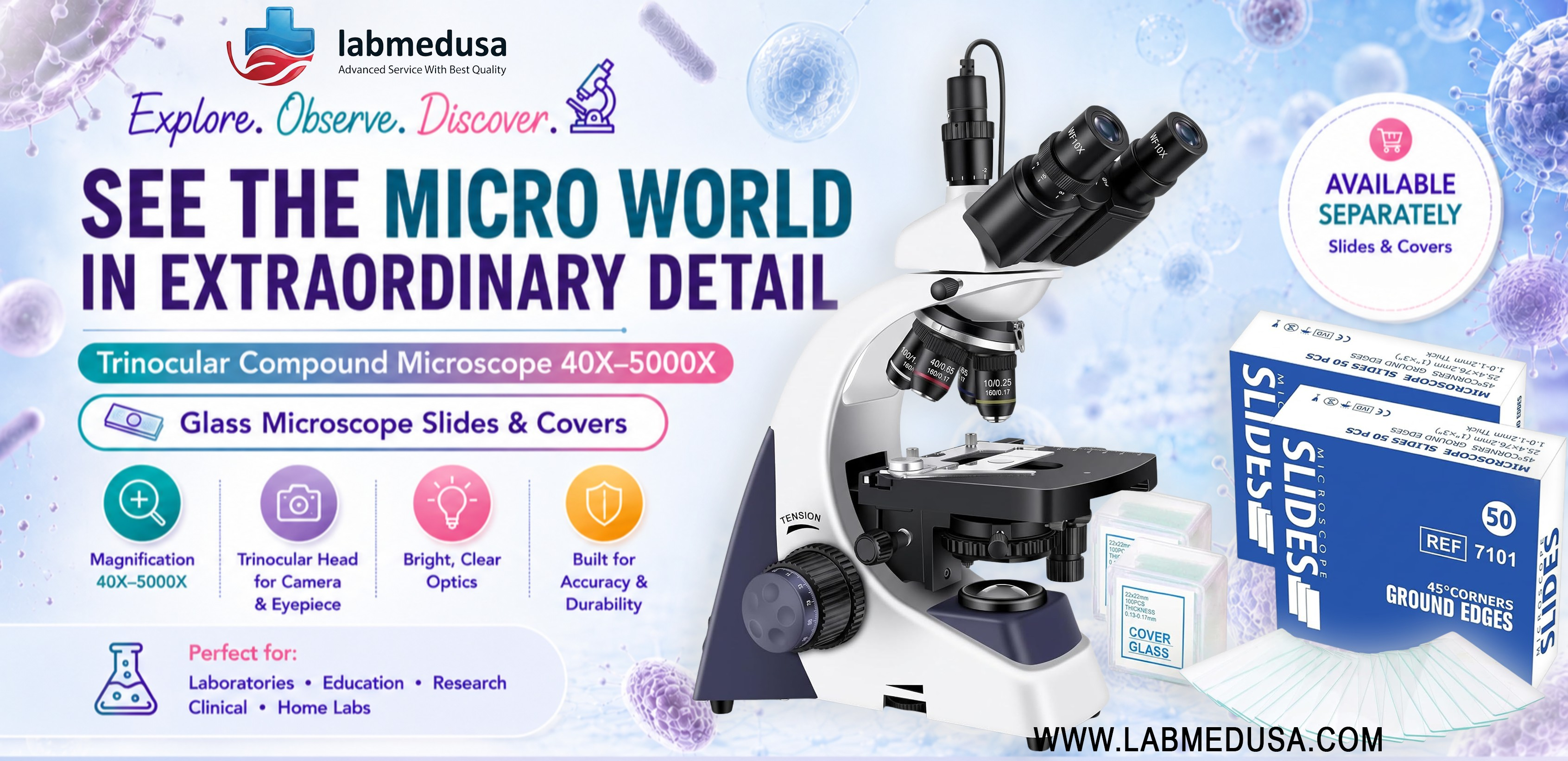
Trinocular Compound Microscope 40X-5000X: A Complete Guide for Labs, Classrooms, and Clinical Observation
Microscopy remains one of the most important tools in science education, clinical observation, and laboratory research. Whether you are studying cells, examining prepared slides, documenting specimens, or teaching students how to use optical instruments, the right microscope setup can make a major difference in clarity, efficiency, and results.
The Trinocular Compound Microscope 40X-5000X is designed to support that work with a combination of high magnification, advanced optics, digital imaging, and practical accessories. When paired with glass microscope slides and coverslips, it becomes a versatile solution for everyday laboratory use, STEM classrooms, and professional specimen viewing.
What Is a Trinocular Compound Microscope?
A trinocular compound microscope is a microscope with three viewing paths: two eyepieces for direct observation and a third port for attaching a camera. This design is especially useful when users want to observe specimens through the eyepiece while also capturing photos or live video through a digital device.
Compared with a standard binocular microscope, a trinocular model gives you more flexibility. You can:
- view samples directly through the eyepieces,
- connect a camera for documentation,
- share images in presentations or online classes,
- record videos for training or review.
For laboratories, schools, and research environments, this makes the trinocular microscope a practical choice for both hands-on work and digital communication.
Why 40X-5000X Magnification Matters
Magnification is one of the first things people look at when choosing a microscope. A range of 40X to 5000X provides broad versatility for different types of viewing.
At lower magnification, users can locate and identify the general structure of a specimen. At higher magnification, they can examine more detailed features such as cell walls, tissue organization, or fine structural patterns.
This wide magnification range is useful for:
- classroom demonstrations,
- biology education,
- specimen screening,
- clinical training,
- basic research,
- hobby microscopy.
A microscope with a wide usable range helps reduce the need to switch between multiple instruments during routine observation.
Optical Performance: Why the Infinity System and 195 Achromatic Objectives Matter
The optical quality of a microscope is just as important as its magnification. The Trinocular Compound Microscope features a real 195 achromatic objective lens paired with an infinity optical system. These features are designed to improve image clarity and color accuracy.
Achromatic Objective Lenses
Achromatic lenses help reduce color distortion, also known as chromatic aberration. This means the image appears cleaner, sharper, and more true to life. For users who need detailed observation, this is essential.
Infinity Optical System
An infinity optical system improves image formation and flexibility in the optical path. It helps produce clearer, brighter images and supports better resolution when used with additional optical accessories or cameras.
Together, these optical features support more reliable viewing of cellular and microscopic structures.
HD USB Camera Integration for Digital Microscopy
One of the most useful features of a trinocular microscope is the ability to connect a camera. This model includes an HD USB camera, also described as an electronic eyepiece, which allows the microscope to connect directly to a computer.
This is especially useful for:
- capturing high-resolution images,
- recording live video,
- saving specimen observations,
- creating lab documentation,
- teaching students remotely,
- sharing findings in real time.
Digital documentation is now an important part of modern microscopy. Instead of relying only on visual observation, users can save results, compare images later, and present findings in a more professional way.
For classrooms, this feature allows instructors to display specimens to an entire group. For laboratories, it supports recordkeeping and collaboration.
Precision Mechanical Stage and Focusing Controls
Clear imaging depends not only on optics but also on accurate specimen movement and focusing. This microscope includes a double-layer dual mechanical stage, which helps users move slides smoothly along the X-Y axis.
Why the Mechanical Stage Is Important
A mechanical stage allows fine, controlled movement of the slide. This is important when you need to:
-
- center a specimen,
- scan a slide systematically,
- compare multiple sample areas,
- make precise adjustments during observation.
Coarse and Fine Focusing
The microscope also includes dual coaxial coarse and fine focus knobs. These knobs help users bring the specimen into sharp focus with greater control.
-
- Coarse focus is used for larger adjustments and initial image setup.
- Fine focus is used for precise sharpening, especially at higher magnifications.
This combination improves usability for beginners and experienced users alike.
Ergonomic Design for Longer Viewing Sessions
Microscope use can take time, especially during labs, demonstrations, or research sessions. That is why ergonomic features matter.
This trinocular microscope has a 45-degree angled, 360-degree swiveling head, which supports more comfortable viewing positions. It also includes adjustable pupillary distance and refractive index settings to help users customize the instrument for their vision needs.
These design details help reduce strain during extended observation and make the microscope more practical for shared use in classrooms or laboratories.
Why Glass Microscope Slides and Covers Are Essential
Even the best microscope cannot perform well without a proper slide preparation system. That is why glass microscope slides and coverslips are a must-have for any lab, classroom, or STEM toolkit.
The 100 Microscope Slides and 200 Coverslips Set is designed to support routine specimen mounting and observation.
What the Set Includes
- 100 blank microscope slides
- 200 square coverslips
- protective moisture-resistant inner boxes
This gives you a reliable supply for daily use, practice sessions, and educational demonstrations.
Why Clear Optical Glass Is Important
These slides and coverslips are made from high-transmittance optical glass. This matters because light must pass through the sample and glass with minimal distortion.
Clear optical glass supports:
- better light transmission,
- improved image visibility,
- more accurate specimen observation,
- cleaner results under standard magnification.
When using a compound or trinocular microscope, slide quality can directly affect what you see.
Standard Size for Universal Compatibility
The slides are manufactured at the standard 1 x 3 inches (25.4 x 76.2 mm) size. This is the common format used by most traditional compound, trinocular, and digital microscopes.
The coverslips are sized at 0.87 x 0.87 inches (22 x 22 mm), with standard thickness specifications suitable for typical lab viewing.
Universal sizing is important because it helps ensure proper placement on the stage and consistent sample positioning.
Ground Edges and Clipped Corners for Easier Handling
The slide set is designed with carefully ground edges and 45-degree clipped corners. These features improve handling during frequent use.
Benefits include:
- smoother slide handling,
- reduced risk of rough edges,
- easier organization in busy lab settings,
- more beginner-friendly use in classrooms.
These practical details are especially useful when many slides are being prepared, moved, or cleaned during a lab session.
Best Uses for a Trinocular Microscope and Slide Set
This combination is ideal for a wide range of microscopy activities.
1. Biology Education
Students can learn how to observe cells, tissues, and organisms while instructors display the specimen through the camera output.
2. Classroom Demonstrations
Teachers can project live images from the microscope to support group learning.
3. Clinical and Laboratory Training
The setup supports visual inspection, sample documentation, and microscopy practice.
4. STEM Projects
Students and hobbyists can prepare their own slides and study plant, animal, or synthetic samples.
5. Specimen Documentation
The HD USB camera allows users to capture images and record observations for reports or presentations.
How to Choose Microscope Slides and Coverslips for Best Results
When selecting slides and covers for microscopy, consider the following:
- Material quality: optical glass is preferred for clarity.
- Standard sizing: make sure the slides fit your stage.
- Edge finish: ground edges reduce handling issues.
- Packaging: moisture-resistant storage helps protect supplies.
- Quantity: larger packs are better for frequent use.
A reliable slide and coverslip set supports consistent specimen mounting and better viewing results.
Tips for Better Microscopy Results
To get the most out of your trinocular compound microscope, follow these best practices:
- start with lower magnification and move higher gradually,
- clean slides and coverslips before use,
- adjust lighting properly for the specimen type,
- center the slide carefully on the mechanical stage,
- use fine focus at higher magnification,
- store glass accessories in protective packaging,
- keep the dust cover on when the microscope is not in use.
These simple steps can improve clarity and help preserve your equipment.
Frequently Asked Questions
What is a trinocular microscope used for?
A trinocular microscope is used for direct specimen viewing and digital imaging. It is ideal for labs, classrooms, demonstrations, and documentation.
Why choose a microscope with a USB camera?
A USB camera makes it easier to capture photos, record videos, and share live specimen views on a computer.
Are 100 slides and 200 coverslips enough for classroom use?
Yes, this quantity is well suited for classroom activities, practice sessions, and regular lab observation.
Can these slides work with most compound microscopes?
Yes. The standard 1 x 3 inch slide size is compatible with most traditional compound, trinocular, and digital microscopes.
Why are optical glass slides better?
Optical glass offers better transparency and light transmission, which helps support clearer specimen viewing.
Final Thoughts
A high-quality microscope setup should do more than magnify. It should deliver sharp optics, smooth mechanical control, digital documentation, and dependable accessories that support real-world use.
The Trinocular Compound Microscope 40X-5000X offers a professional optical system, HD USB camera integration, ergonomic viewing features, and a complete accessory package. When paired with glass microscope slides and coverslips, it becomes a practical choice for laboratories, educators, students, and anyone serious about microscopy.
For anyone looking for a trinocular compound microscope, compound microscope with camera, microscope slides and coverslips, or a complete microscopy kit for lab and STEM use, this setup provides a strong balance of performance, convenience, and educational value.
Find the Trinocular Compound Microscope 40X-5000X on LabMedUSA
Find the Glass microscope slides and coverslips on LabMedUSA



Leave a comment