



10mL Sterile Transport Tubes for COVID-19 Swab Specimens: What Labs Need to Know
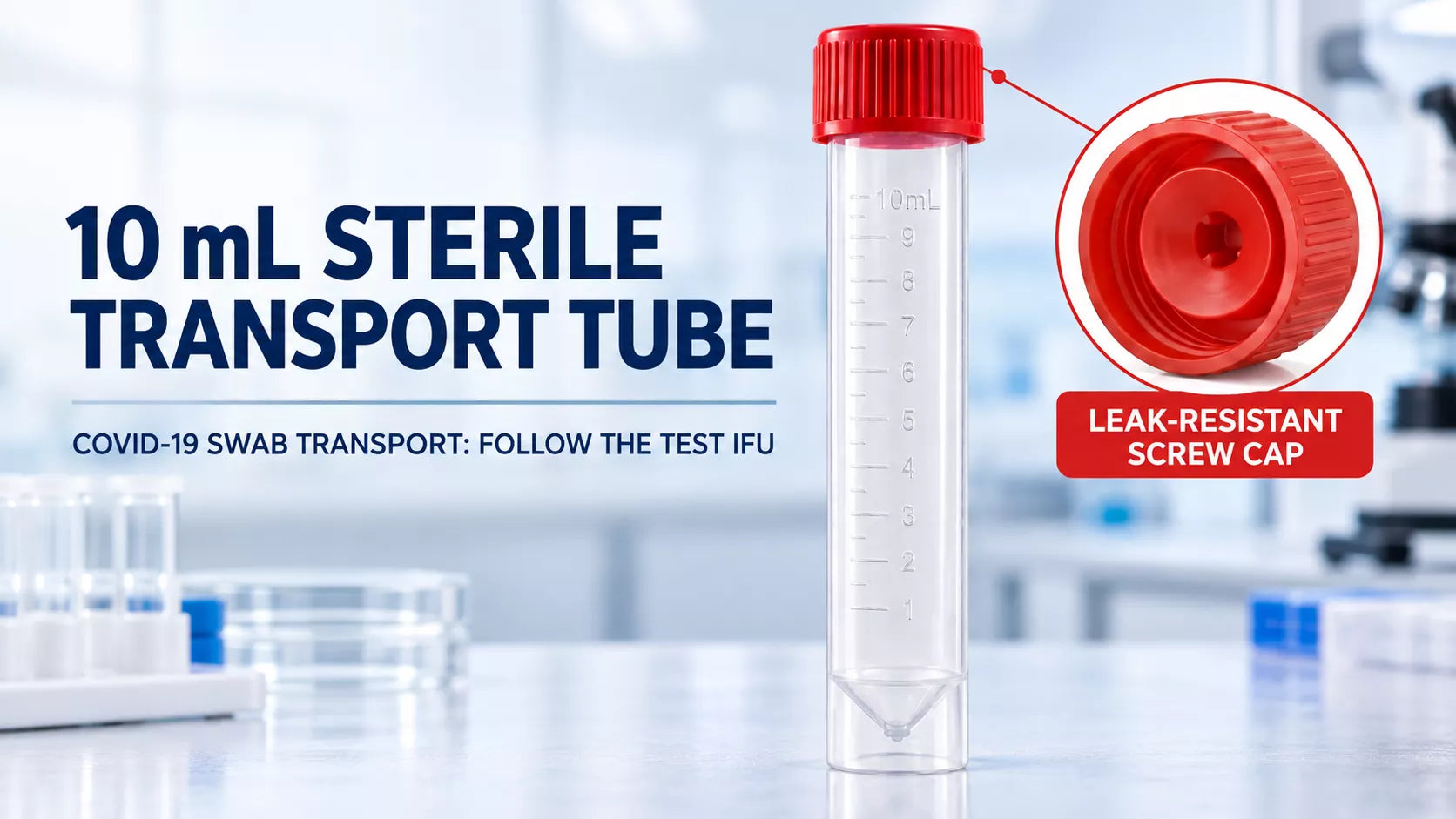
A sterile transport tube is a small but important part of the preanalytical workflow for respiratory specimen testing. The LabMedUSA 10mL sterile transport tube is a clear, medical-grade polypropylene tube with molded volume markings and a secure red screw cap. It is designed to contain biological specimens during routine handling and transport.
Can this 10mL transport tube be used to hold a swab specimen for COVID-19 testing? Potentially, yes, but only when the test manufacturer's instructions for use, the receiving laboratory, and the facility's validated procedure permit that exact setup.
The tube is not automatically a complete COVID-19 specimen collection kit. A valid testing workflow may also require a particular swab, a specified volume and type of transport medium, defined storage conditions, compliant labeling, and approved secondary and outer packaging. An empty sterile tube does not replace viral transport medium and does not preserve a specimen by itself.
What Is the LabMedUSA 10mL Sterile Transport Tube?
The product is a sterile, 10mL polypropylene specimen transport tube intended for laboratory sample handling. Key specifications are:
| Product detail | Published specification | Why it matters |
|---|---|---|
| Nominal volume | 10 mL | Provides room for a swab and an assay-approved volume of transport medium when the protocol permits it |
| Tube material | Medical-grade polypropylene (PP) | Provides a durable, lightweight container for biological specimens and laboratory reagents |
| Closure | Screw cap listed as leakproof, with a leak-resistant seal | Helps maintain a closed primary receptacle during routine handling |
| Sterility | Sterile | Supports workflows that require a sterile specimen container |
| Volume markings | Molded graduations | Allow quick visual estimation of liquid volume |
| Packaging | 500 tubes per pack | Supports clinics, laboratories, screening programs, and other higher-volume operations |
| Listed applications | Urine, blood, biological specimens, and reagent preparation | Shows that the tube is a multipurpose laboratory container, subject to the requirements of each intended procedure |
| Centrifugation | Described as compatible with moderate centrifugation forces | Any actual speed, relative centrifugal force, duration, and temperature should be confirmed before use because no maximum RCF is published on the product page |
The supplied product image also shows a tall, clear tube with molded 1 to 10 mL graduations, an internal conical bottom, an outer standing skirt, and a ribbed red cap. These physical features can make visual inspection, upright bench handling, and controlled liquid recovery more convenient.
Can a 10mL Transport Tube Be Used for a COVID-19 Swab?
The short answer: A sterile 10mL tube may be the primary container in a COVID-19 swab transport workflow, but only if the selected diagnostic test and receiving laboratory accept it.
The CDC's current clinical specimen guidance says that the specimen type must be selected according to the test being performed and the manufacturer's instructions. It also tells healthcare providers to confirm that the receiving laboratory will accept the specimen before collection. For upper respiratory specimens, the CDC advises using sterile swabs and placing the collected swab into the transport tube provided.
Those details matter because SARS-CoV-2 assays do not all use the same specimen transport system. For example, one FDA-posted molecular test instruction accepts flocked plastic-shaft swabs in viral transport medium or universal transport medium, while another FDA-posted assay instruction specifies defined volumes of viral transport medium, saline, or eNAT. A different test may use a direct swab or a proprietary tube. The acceptable combination is assay-specific.
This tube may fit the workflow when:
-
The diagnostic test instructions allow a sterile polypropylene transport tube of suitable size.
-
The receiving laboratory has confirmed that it accepts the tube and closure.
-
The specified swab fits inside without forcing, bending, or preventing full cap closure.
-
The required transport medium and fill volume are compatible with the tube.
-
The facility has validated or otherwise authorized the complete collection and transport process.
-
Storage time, temperature, labeling, and packaging follow the test instructions and laboratory procedure.
Do not assume the tube is suitable when:
-
The test requires its own proprietary collection device.
-
The test instructions specify a different tube material, tube size, medium, swab, or fill volume.
-
The receiving laboratory has not approved dry swab transport in this container.
-
The cap cannot close completely after the swab shaft is inserted or broken at its intended breakpoint.
The Tube Is Not the Same as Viral Transport Medium
One of the most important distinctions in COVID-19 specimen collection is the difference between a transport tube and transport medium.
| Component | Primary function | What it does not establish by itself |
|---|---|---|
| Sterile transport tube | Physically contains the specimen | Assay compatibility, viral preservation, or COVID-19 authorization |
| Collection swab | Collects material from an approved anatomical site | Proper transport conditions after collection |
| VTM, UTM, saline, eNAT, or another approved medium | Provides the liquid or chemical environment specified for the assay | Compatibility with every SARS-CoV-2 test |
| Test instructions for use | Defines accepted specimen types, swabs, media, volumes, and handling conditions | Acceptance by a different assay or laboratory |
| Secondary and outer packaging | Adds containment and physical protection during transport | Suitability of the primary tube or test method |
The LabMedUSA product page does not state that viral transport medium, universal transport medium, saline, preservation buffer, or a collection swab is included. It should therefore be treated as a tube product, not as a prefilled VTM kit, unless the packaging and current technical documents say otherwise.
Do not add a medium simply because it is commonly used for respiratory testing. The correct medium, volume, swab, and tube combination must come from the applicable test instructions and laboratory protocol. Using an unapproved transport medium can dilute a sample, interfere with an assay, or cause the laboratory to reject the specimen.
Why the Airtight Cap Matters in Specimen Transport
Many buyers search for an "airtight cap specimen tube" because secure closure is essential when biological material moves from a collection area to a laboratory. The red ribbed cap is designed to be easy to grip and tighten, while its internal sealing surface creates a close barrier at the mouth of the tube.
For precise product language, the current LabMedUSA listing calls the cap "leakproof" and describes the closure as a "leak-resistant seal." The phrase "airtight cap" is a useful plain-language description of a tightly closed screw cap, but it should not be interpreted as proof of hermetic gas-tightness, a specified vapor transmission rate, or certified pressure performance unless those claims are supported by the current technical data.
A properly secured screw cap can help:
-
Reduce the chance of liquid leakage during routine upright handling.
-
Limit accidental exposure to the specimen.
-
Help protect the sample from external contamination.
-
Reduce cross-contamination risk between nearby specimens.
-
Keep the swab and any approved transport medium enclosed until processing.
The cap cannot compensate for an incompatible swab, the wrong transport medium, improper temperature control, delayed delivery, incorrect labeling, or inadequate shipping packaging. If a procedure requires a 95 kPa pressure-tested primary receptacle, request documented pressure-test data for the exact product rather than relying on the words airtight or leakproof alone.
How the Tube Fits Into a Controlled COVID-19 Swab Workflow
The following is a procurement and process overview, not a patient collection procedure. Clinical specimen collection should be performed only by appropriately trained personnel or through an authorized self-collection process.
-
Start with the test instructions. Identify the exact SARS-CoV-2 assay and read its current instructions for accepted specimen type, swab, transport medium, volume, storage, and transport.
-
Confirm receiving-laboratory acceptance. Before collection, verify that the laboratory accepts this tube, the planned medium, and the selected swab. The CDC explicitly recommends confirming specimen acceptance in advance.
-
Check physical compatibility. Make sure the swab shaft and intended breakpoint allow the swab to sit inside the tube without obstructing the screw threads or closure.
-
Use only the specified medium. If the method requires VTM, UTM, saline, eNAT, or another medium, use the type and volume allowed by the test instructions. If it allows a dry sterile transport device, follow that procedure exactly.
-
Close and identify the specimen. Tighten the screw cap according to the facility procedure and apply the required patient identifiers, specimen source, collection date, and collection time without obscuring essential volume markings.
-
Maintain required conditions. Follow the assay and laboratory instructions for holding time, refrigeration or freezing, and protection from temperature excursions. There is no single storage rule that applies to every COVID-19 test.
-
Package for transport. Use the secondary packaging, absorbent material, outer packaging, marks, labels, and trained shipper required by the route and applicable regulations. A leak-resistant primary tube is only one part of a compliant transport package.
Benefits of a 10mL Polypropylene Specimen Transport Tube
When it is approved for the intended method, a 10mL sterile transport tube can offer several practical advantages.
Useful working space: The tube can accommodate a swab and an assay-approved amount of transport medium while leaving handling space. The nominal tube capacity does not mean it should be filled to 10 mL for a COVID-19 swab. Use only the volume specified by the test.
Visible molded graduations: The 1 to 10 mL markings support quick visual checks during laboratory handling. Molded graduations should be treated as estimates unless the product documentation states a measurement tolerance.
Durable polypropylene construction: Polypropylene is lightweight and well suited to many general laboratory workflows. Compatibility with a specific reagent, disinfectant, temperature, or analytical method still requires confirmation.
Secure red screw cap: The ribbed cap provides a large gripping surface and a tight closure. Its distinctive red color can also support visual organization when that color assignment is defined in the laboratory's own system.
Multipurpose inventory: LabMedUSA lists urine, blood, biological specimens, and reagent preparation among the product's uses. Each application still requires the appropriate validated procedure and specimen-container requirements.
Common Mistakes With COVID-19 Swab Transport Tubes
Calling an empty tube a VTM tube: A tube containing no medium is not a viral transport medium tube. VTM describes the medium and its validated system, not simply the container.
Using any available saline or buffer: The test instructions determine whether saline, VTM, UTM, eNAT, another medium, or direct swab processing is acceptable.
Treating leak-resistant as ship-ready: A secure cap helps contain the specimen, but transport may also require absorbent material, leakproof secondary packaging, rigid outer packaging, temperature controls, and regulated markings.
Ignoring the swab breakpoint: A shaft that is too long can prevent complete cap closure. Confirm fit before the tube is introduced into a live clinical workflow.
Relying on a generic storage schedule: Storage time and temperature depend on the assay, medium, specimen type, and laboratory procedure.
Frequently Asked Questions About 10mL COVID-19 Swab Transport Tubes
Can I place a COVID-19 nasal swab directly into this 10mL tube?
Only if the test instructions and receiving laboratory permit that dry sterile transport configuration. Many molecular workflows require the swab to be placed into a specified transport medium, while some tests use a direct swab or proprietary device.
Is the red cap airtight?
The cap is commonly described in plain language as airtight because it forms a tight screw closure. The supported product-page terms are leakproof and leak-resistant.
Is a leak-resistant tube enough for courier or air shipment?
No. Biological specimen transport can require a complete packaging system with a primary receptacle, absorbent material for liquids, secondary packaging, and outer packaging. Classification, pressure performance, documentation, marks, and labels depend on the specimen and shipping route.
Is a 10mL tube too large for a COVID-19 swab?
Not necessarily. Tube capacity and required fill volume are different. Some assay instructions use only a few milliliters of approved medium. The important questions are whether the swab fits, the tube closes fully, the required medium volume is correct, and the receiving laboratory accepts the container.
Choosing a Reliable 10mL Sterile Transport Tube
A reliable transport tube should match the full testing workflow. Sterility, polypropylene construction, visible graduations, adequate capacity, and a secure screw cap are valuable features, but assay compatibility remains the deciding factor for COVID-19 swab specimens.
For laboratories, clinics, universities, public health programs, and research facilities that need a multipurpose specimen tube, the LabMedUSA 10mL sterile screw-cap transport tube offers a clear polypropylene body, molded volume markings, sterile packaging, and a leak-resistant red cap. Review the current product documentation and confirm your laboratory protocol before placing it into clinical service.
Final Takeaway
The LabMedUSA 10mL transport tube can be a useful physical container for biological specimens and may fit some COVID-19 swab transport workflows. Its sterile polypropylene body, molded graduations, and tightly closing, leak-resistant screw cap support controlled specimen handling.
Before use, match the tube to the current test instructions and laboratory SOP. That is the best way to protect specimen integrity, reduce rejection risk, and make the most of a 10mL sterile transport tube.
Educational information only. This article is not a specimen-collection instruction, medical advice, regulatory approval, or substitute for the diagnostic test manufacturer's instructions, the receiving laboratory's requirements, or applicable transport regulations.
Research Sources
-
CDC: Interim Guidelines for Collecting and Handling of Clinical Specimens for COVID-19 Testing
-
WHO: Guidance on Regulations for the Transport of Infectious Substances, 2021-2022



Leave a comment