



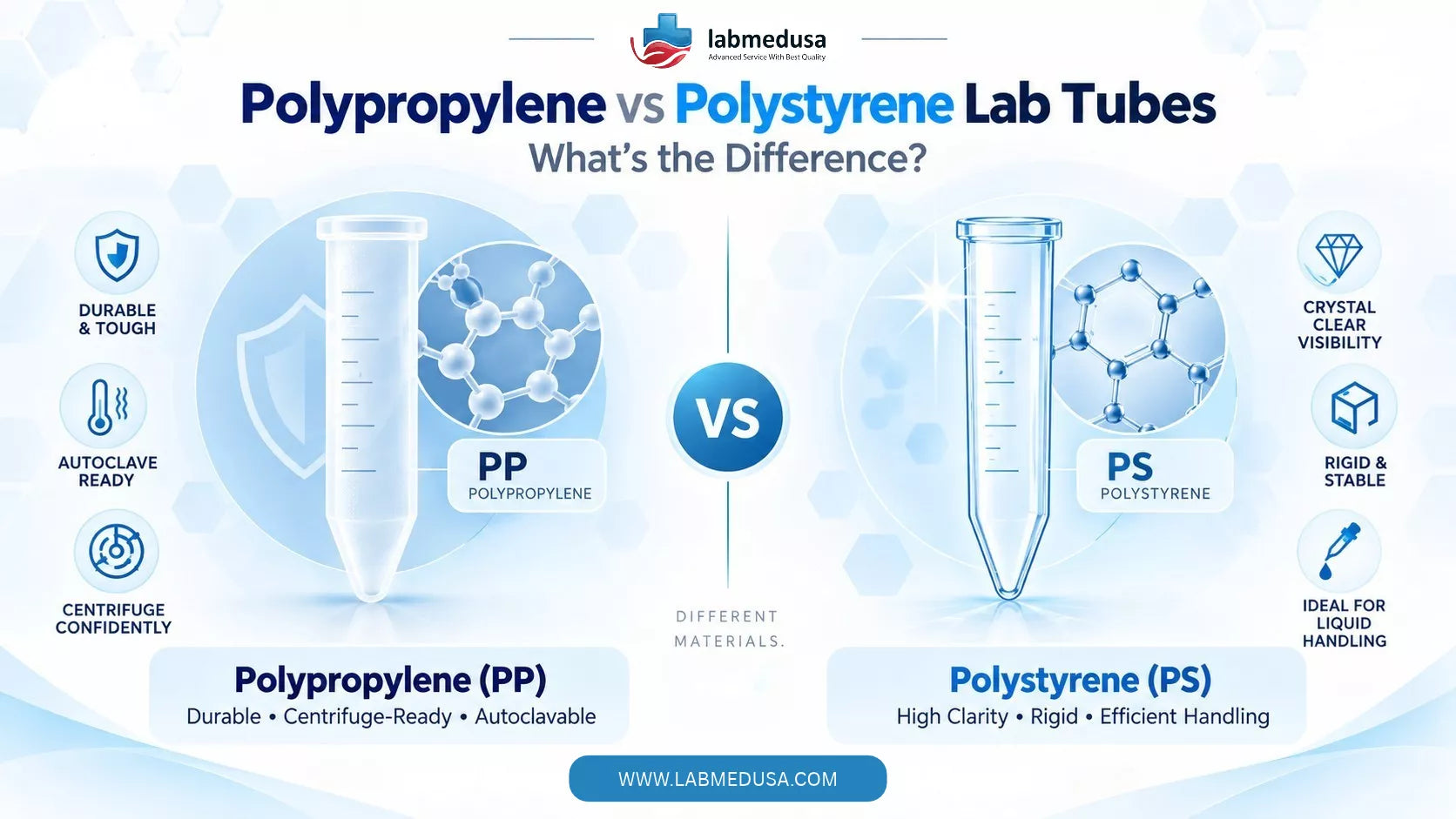
Polypropylene vs Polystyrene Lab Tubes: What’s the Difference?
Polypropylene vs Polystyrene Lab Tubes: What’s the Difference?
When choosing laboratory tubes, capacity, shape, closure, sterility, and graduation markings are important. Another specification that deserves attention is the plastic material used to manufacture the tube.
Two commonly used plastics in laboratory consumables are polypropylene (PP) and polystyrene (PS).
Although both materials are used for laboratory tubes and sample-handling products, their physical characteristics are different. Understanding the difference between polypropylene vs polystyrene lab tubes can help laboratories, researchers, educational facilities, and purchasing teams select tubes that better match their intended workflow.
This guide explains the general differences between PP and PS laboratory tubes, including clarity, rigidity, durability, temperature resistance, chemical compatibility, centrifugation considerations, and common applications.
What Is Polypropylene?
Polypropylene, commonly abbreviated PP, is a thermoplastic material widely used in laboratory plasticware.
Polypropylene is known for its combination of toughness, relatively high temperature resistance, and compatibility with many common laboratory chemicals.
It is frequently used to manufacture products such as:
-
Centrifuge tubes
-
Microcentrifuge tubes
-
Transport tubes
-
Sample storage tubes
-
Pipette tips
-
Laboratory bottles
-
Caps and closures
-
Other disposable laboratory consumables
Polypropylene tubes are often translucent or clear enough to allow sample observation, although their appearance can vary depending on the formulation and manufacturing process.
One important point is that PP describes the material, not the complete performance specification of the tube.
A polypropylene tube should not automatically be assumed to be autoclavable, sterile, chemically compatible with every reagent, or suitable for a specific centrifuge speed. Those specifications should be confirmed for the individual product.
What Is Polystyrene?
Polystyrene, commonly abbreviated PS, is a rigid thermoplastic known for its high optical clarity.
Polystyrene can provide a glass-like transparent appearance, making it useful for laboratory applications where visual observation of the contents is important.
PS is commonly used for products such as:
-
Test tubes
-
Culture tubes
-
Sample tubes
-
Liquid handling tubes
-
Disposable laboratory containers
-
Petri dishes
-
Multiwell plates
-
Educational laboratory consumables
Compared with polypropylene, polystyrene is generally more rigid but also more brittle.
Its high transparency can make it easier to inspect samples, liquid levels, color changes, or visible separation inside the tube.
Polypropylene vs Polystyrene Lab Tubes at a Glance
| Feature | Polypropylene (PP) | Polystyrene (PS) |
|---|---|---|
| Appearance | Usually translucent to clear | Typically highly transparent |
| Rigidity | Semi-rigid to rigid | Rigid |
| Toughness | Generally higher impact resistance | More brittle |
| Chemical resistance | Good resistance to many common laboratory chemicals | Suitable for many aqueous solutions but more limited with some solvents |
| Heat resistance | Generally higher | Lower |
| Autoclaving | Some PP products may be autoclavable when specifically designed and rated for it | Standard PS products are generally not intended for autoclaving |
| Centrifugation | Common material for centrifuge tubes, subject to the specific tube's RCF rating | Use for centrifugation only when the specific PS tube is rated for it |
| Sample visibility | Good | Excellent |
| Common applications | Centrifugation, storage, transport, preparation, general laboratory use | Liquid handling, sample observation, culture, disposable test tubes |
These characteristics are general material differences.
Actual tube performance can also depend on:
-
Wall thickness
-
Tube geometry
-
Resin formulation
-
Manufacturing process
-
Tube capacity
-
Closure design
-
Temperature
-
Chemical exposure
-
Centrifugal force
Always check the specifications of the individual laboratory tube before use.
Which Material Provides Better Sample Visibility?
Polystyrene generally provides greater optical clarity than polypropylene.
PS laboratory tubes are often selected when clear visual observation is useful.
High-clarity tubes can make it easier to view:
-
Liquid color
-
Sample level
-
Visible particles
-
Layers or separation
-
General sample appearance
Polypropylene can also provide good sample visibility, particularly when manufactured as a clear or natural laboratory tube.
However, the appearance of PP is generally more translucent than the glass-like clarity commonly associated with PS.
This makes polystyrene laboratory tubes useful for workflows where visual inspection is a priority.
Which Is More Durable: PP or PS?
Polypropylene is generally tougher and more resistant to impact than polystyrene.
Polystyrene is rigid, but rigidity does not necessarily mean greater durability.
PS tends to be more brittle, which means it can be more susceptible to cracking under impact or mechanical stress.
Polypropylene can often tolerate greater flexing or impact without cracking.
This distinction can be important when choosing tubes for:
-
Frequent handling
-
Sample transport
-
Centrifugation
-
Storage
-
Busy clinical or research environments
For workflows where mechanical durability is important, polypropylene may offer an advantage.
PP vs PS Chemical Resistance
Chemical compatibility is an important consideration when selecting plastic laboratory tubes.
Polypropylene generally provides broader chemical resistance than polystyrene.
PP is commonly compatible with many:
-
Dilute acids
-
Dilute bases
-
Alcohols
-
Aqueous buffers
-
Saline solutions
-
Common laboratory reagents
However, polypropylene is not resistant to every chemical.
Compatibility can depend on:
-
Chemical concentration
-
Exposure time
-
Temperature
-
Mechanical stress
-
Tube formulation
Polystyrene is suitable for many water-based and routine laboratory solutions but can be more sensitive to certain organic solvents and aggressive chemicals.
For any critical laboratory procedure, chemical compatibility should be confirmed for the exact material, chemical, temperature, and exposure conditions.
Can Polypropylene Lab Tubes Be Autoclaved?
Some polypropylene laboratory products are designed to tolerate autoclaving, but this should not be assumed for every PP tube.
Polypropylene generally has better heat resistance than polystyrene.
However, whether an individual laboratory tube can be autoclaved depends on more than the base plastic.
Other factors can include:
-
Wall thickness
-
Printed graduations
-
Labels
-
Tube caps
-
Seals
-
Liners
-
Manufacturing additives
-
Product design
If the tube specifications do not clearly state that the product is autoclavable, it is safer not to assume that it can withstand an autoclave cycle.
Can Polystyrene Lab Tubes Be Autoclaved?
Standard polystyrene laboratory tubes are generally not intended for steam autoclaving.
Polystyrene has lower heat resistance than polypropylene and may soften, deform, or become damaged when exposed to high autoclave temperatures.
This does not mean a PS product cannot be supplied sterile.
A laboratory tube can be manufactured and sterilized using another process without being suitable for repeated steam autoclaving.
Therefore:
Sterile does not automatically mean autoclavable.
The two specifications should be evaluated separately.
PP vs PS for Centrifugation
Polypropylene is commonly used to manufacture centrifuge tubes because of its toughness and ability to handle mechanical stress.
However, the letters PP alone do not tell you how fast a tube can safely be centrifuged.
The most important specification is the manufacturer's maximum relative centrifugal force, or RCF.
Centrifuge performance can be affected by:
-
Tube wall thickness
-
Tube shape
-
Fill volume
-
Rotor design
-
Temperature
-
Tube condition
-
Cap design
-
Centrifugation time
The same precaution applies to polystyrene.
Some PS tubes may be designed for limited centrifugation, while others are intended only for routine liquid handling or sample observation.
Never assume that a laboratory tube is centrifuge-safe simply because of its material or shape.
Always follow the RCF rating specified for the individual tube.
PP vs PS for Sample Observation
One of the strongest characteristics of polystyrene is its optical transparency.
High-clarity PS laboratory tubes may be useful for applications where users need to visually inspect the sample during handling.
Examples can include:
-
Observing liquid color
-
Checking fill level
-
Viewing visible separation
-
Routine sample preparation
-
Educational demonstrations
-
General laboratory liquid handling
Polypropylene may be preferred when toughness, chemical resistance, heat tolerance, or centrifugation requirements are more important.
A simple way to understand the difference is:
PP is commonly chosen for toughness and broader laboratory versatility.
PS is commonly chosen when high clarity and rigidity are important.
Neither material is automatically the better choice for every laboratory procedure.
LabMedUSA Polypropylene and Polystyrene Tube Options
LabMedUSA carries laboratory tubes manufactured from both polypropylene and polystyrene, allowing laboratories to select different materials depending on their workflow.
15 mL Polypropylene Conical Centrifuge Tube
LabMedUSA's 15 mL polypropylene tube features:
-
15 mL capacity
-
Polypropylene construction
-
Conical bottom
-
Clear or natural appearance
-
Printed graduations
-
Approximately 17 mm outer diameter
-
Approximately 120 mm height
-
Open-top format without an included cap
The tube is designed as a polypropylene centrifuge tube for general laboratory sample handling and centrifugation applications.
Specific centrifugation conditions should always follow the product specifications and laboratory protocol.
15 mL High-Clarity Polystyrene Liquid Handling Tube
LabMedUSA also offers a 15 mL tube manufactured from high-clarity polystyrene.
Features include:
-
15 mL capacity
-
High-clarity PS material
-
Conical bottom
-
Approximately 17 mm diameter
-
Approximately 120 mm height
-
Open-top design
-
No cap included
-
Bulk laboratory packaging
This PS tube is suited to general sample preparation, routine liquid handling, research, educational laboratories, and other workflows where clear sample visibility is useful.
Although these PP and PS tubes have similar dimensions and capacities, the different materials provide different physical properties.
This is why tube volume alone should not determine which laboratory tube is selected.
How to Choose Between Polypropylene and Polystyrene Lab Tubes
Selecting the appropriate laboratory tube material begins with understanding the actual procedure.
Before purchasing PP or PS tubes, consider the following questions:
-
Will the tube be centrifuged?
-
What RCF will the procedure require?
-
What chemicals will contact the tube?
-
Is high optical clarity important?
-
Will the tube experience elevated temperatures?
-
Does the procedure require sterile tubes?
-
Will autoclaving be necessary?
-
What tube capacity is required?
-
Does the workflow require a cap or closure?
-
Will the tube be used for storage, transport, liquid handling, culture, or centrifugation?
These questions can help narrow down whether a polypropylene centrifuge tube, polystyrene test tube, transport tube, culture tube, or liquid handling tube is appropriate.
Is Polypropylene Better Than Polystyrene?
There is no universal answer.
Polypropylene and polystyrene are useful for different laboratory applications.
Polypropylene may be preferred when the workflow requires:
-
Greater toughness
-
Better resistance to impact
-
Broader chemical compatibility
-
Higher temperature tolerance
-
A material commonly used for centrifuge tubes
Polystyrene may be preferred when the workflow requires:
-
High optical clarity
-
A rigid tube body
-
Easy sample observation
-
Routine liquid handling
-
Disposable laboratory test tubes
The correct choice depends on the procedure and the specifications of the individual product.
Final Takeaway
Understanding the difference between polypropylene and polystyrene laboratory tubes can help laboratories select consumables more appropriately for their workflow.
In general:
-
Polypropylene (PP) is tough, chemically resistant, and capable of tolerating higher temperatures than PS.
-
Polystyrene (PS) provides excellent optical clarity and rigidity but is generally more brittle.
-
Polypropylene is commonly used for centrifuge tubes, but the individual product's RCF rating must still be checked.
-
Polystyrene should only be centrifuged when the individual tube is specifically rated for the intended centrifugal force.
-
Some PP laboratory products are autoclavable, but this should only be assumed when the product specifications clearly state it.
-
Standard PS tubes are generally not intended for steam autoclaving.
-
Neither PP nor PS is automatically suitable for every chemical or laboratory procedure.
When comparing PP vs PS lab tubes, plastic test tubes, centrifuge tubes, sample tubes, transport tubes, culture tubes, and liquid handling tubes, always consider the complete product specifications alongside the material.
Choosing the appropriate tube material helps match the laboratory consumable to the sample, procedure, temperature, chemical environment, handling requirements, and visibility needs of the workflow.
For laboratories sourcing everyday consumables and sample-handling products, LabMedUSA offers a range of laboratory tubes, specimen collection supplies, centrifuge tubes, and other laboratory essentials.



Leave a comment