



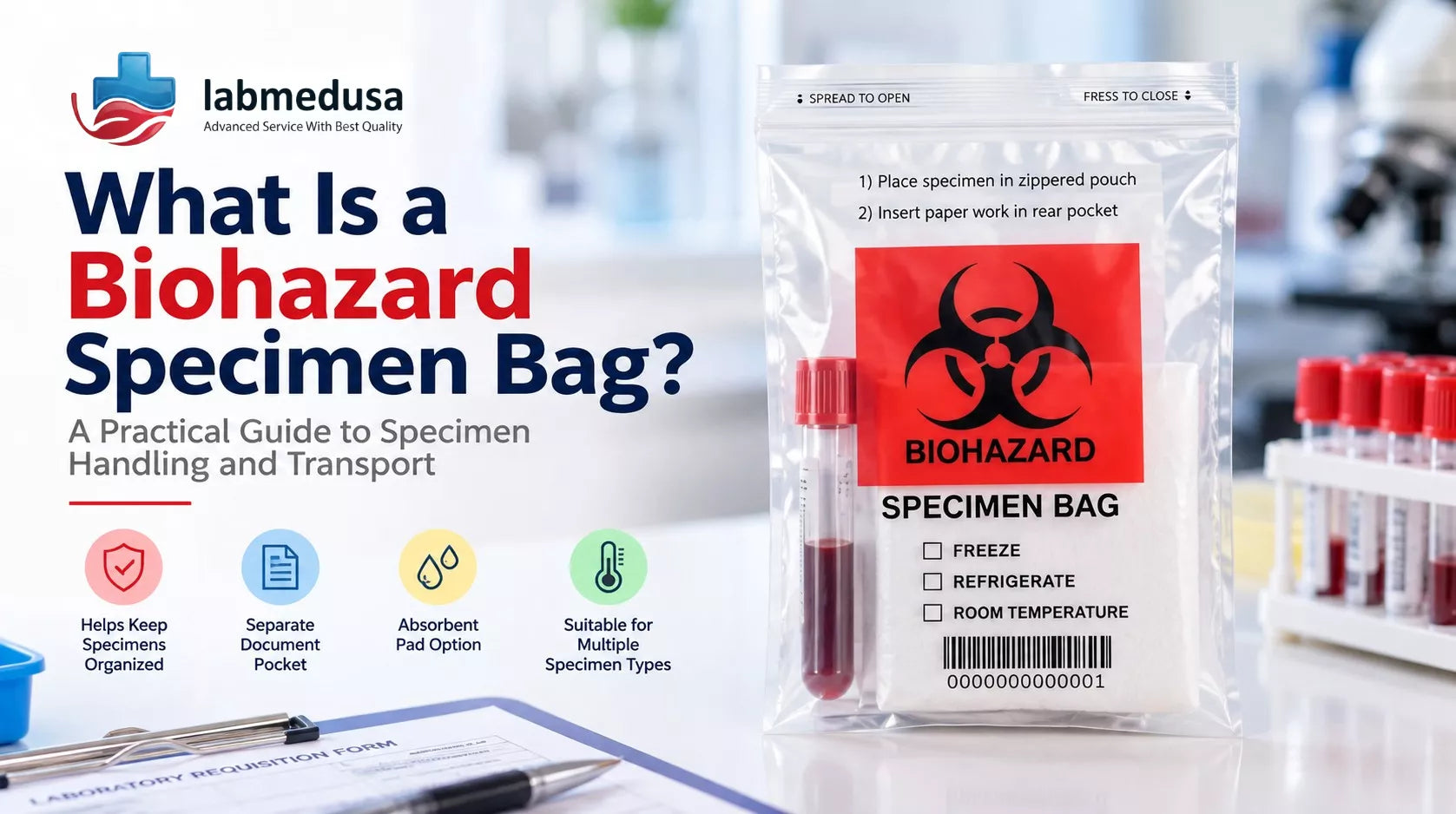
What Is a Biohazard Specimen Bag? A Practical Guide to Specimen Handling and Transport
A biohazard specimen bag is a familiar sight in laboratories, clinics, hospitals, physician offices, and specimen collection sites. Although it may look like a simple plastic bag, it serves an important role in organizing and containing properly closed specimen containers during handling and transport.
These bags are also commonly described as specimen transport bags, laboratory specimen bags, medical specimen bags, biohazard transport bags, sample transport bags, or specimen collection bags.
Depending on the design, a specimen bag may include a resealable closure, printed biohazard symbol, separate document pouch, absorbent material, or other features intended to support organized specimen handling.
Understanding how specimen bags fit into the larger collection and transport process is important because a biohazard bag is only one part of the overall packaging system.
What Is a Biohazard Specimen Bag?
A biohazard specimen bag is generally used to hold a closed primary specimen container during handling or transport.
The specimen itself is first collected into an appropriate primary container. Depending on the type of sample, this could include:
-
Blood collection tubes
-
Urine specimen cups
-
Transport tubes
-
Collection vials
-
Swab transport containers
-
Other laboratory specimen containers
The properly closed primary container may then be placed inside a suitable secondary specimen bag or container according to laboratory procedures.
This additional layer helps separate the specimen container from the surrounding environment and can make specimen organization easier during transfer between collection, receiving, and testing areas.
Primary and Secondary Specimen Containers Explained
Understanding the difference between primary specimen containers and secondary specimen packaging is one of the most important concepts in specimen handling.
Primary specimen container
The primary container directly holds the biological specimen.
Examples include a blood collection tube containing a blood sample or a specimen cup containing a urine sample.
Because the primary container is in direct contact with the specimen, it needs to be appropriate for the specimen type and properly closed before transport.
Secondary specimen packaging
Secondary packaging surrounds the primary specimen container.
A biohazard specimen transport bag can sometimes serve as part of this secondary containment system, depending on the intended application, bag design, laboratory procedures, and transportation requirements.
Secondary packaging provides another physical layer between the specimen container and the surrounding environment.
For certain forms of transportation or shipping, additional packaging may also be required beyond a specimen bag.
Why Are Biohazard Symbols Printed on Specimen Bags?
Many laboratory specimen bags display the recognizable biohazard symbol.
The marking helps healthcare and laboratory personnel quickly recognize that the bag may contain biological material that should be handled according to appropriate procedures.
Biohazard identification is especially useful in busy environments where different types of materials, supplies, documents, and specimens may be handled simultaneously.
However, a printed biohazard symbol does not automatically mean that a particular bag meets every requirement for transporting or shipping biological specimens.
Packaging requirements depend on factors such as:
-
Type of specimen
-
Classification of the material
-
Transportation method
-
Distance traveled
-
Temperature requirements
-
Facility policies
-
Receiving laboratory requirements
-
Applicable transportation regulations
The symbol helps identify the contents, but proper specimen handling still depends on the complete collection and transport procedure.
Why Do Many Specimen Bags Have Two Compartments?
Many specimen bags with document pouches are designed with two separate areas.
One compartment holds the properly closed specimen container.
The second compartment is intended for paperwork or documentation.
This design helps keep documents physically separated from the specimen container.
What may go inside the document pouch?
Depending on laboratory procedures, paperwork may include:
-
Laboratory requisition forms
-
Patient or specimen identification information
-
Test requests
-
Collection information
-
Labels
-
Routing information
-
Other documents required by the receiving laboratory
Separating paperwork from the specimen compartment can help protect documents from moisture or contamination if an unexpected leak occurs.
It can also make receiving easier because staff can access paperwork without immediately opening the specimen compartment.
What Is the Purpose of an Absorbent Pad in a Specimen Bag?
Some biohazard specimen bags with absorbent pads include an absorbent sheet or pad inside the specimen compartment.
Absorbent material provides an additional layer that may help absorb liquid if incidental leakage occurs from the primary container.
However, an absorbent pad should not be treated as a substitute for a properly closed specimen container.
Before transportation, the primary container should be checked according to facility procedures to make sure it is appropriately closed and suitable for the intended specimen.
In certain regulated specimen-shipping situations, the amount and placement of absorbent material may also be specifically defined by packaging requirements.
What Does “2 Mil” Mean on a Specimen Bag?
When comparing medical specimen bags, buyers may see measurements such as 2 mil, 3 mil, or another thickness specification.
A “mil” is a unit used to describe plastic film thickness.
One mil equals 0.001 inch.
Therefore:
2 mil plastic = approximately 0.002 inch thick
Bag thickness can influence characteristics such as flexibility, handling feel, and durability.
However, thickness alone does not determine whether a specimen bag is appropriate for a particular application.
Closure design, material, construction, specimen type, and laboratory requirements also need to be considered.
What Is LDPE in Laboratory Specimen Bags?
Many clear plastic specimen bags are manufactured from LDPE, or low-density polyethylene.
LDPE is a flexible plastic widely used for packaging applications.
It can provide a combination of:
-
Flexibility
-
Transparency
-
Lightweight construction
-
Ease of handling
-
Resistance to normal tearing during routine use
Transparent LDPE specimen bags can also allow staff to visually confirm that a primary specimen container is inside the bag without immediately opening it.
Visibility, however, should never replace proper specimen labeling and identification procedures.
Clear vs Opaque Specimen Transport Bags
Many laboratories use clear specimen bags, although opaque or colored packaging may also be used for certain workflows.
Clear specimen bags
Transparent bags allow visual inspection of the bag's contents.
This can help personnel see:
-
Whether a specimen container is present
-
The general type of container
-
Whether multiple containers are inside
-
Whether the primary container appears upright or displaced
-
Whether obvious leakage may have occurred
Clear bags can therefore be useful for routine specimen organization and receiving.
Opaque specimen bags
Opaque packaging may be preferred when visibility needs to be restricted or when a specific laboratory procedure requires a different type of secondary packaging.
The appropriate choice depends on workflow and facility requirements.
Why Does the Specimen Bag Closure Matter?
The closure is another important feature of a specimen transport bag.
Common specimen bag closure styles can include:
-
Press-to-close zip seals
-
Adhesive seals
-
Tamper-evident closures
-
Drawstring closures
-
Other specialized closure systems
A resealable ziplock specimen bag is commonly used because it can be opened and closed quickly during routine specimen handling.
Other applications may require adhesive, tamper-evident, or specialized closure systems.
There is no single closure style that is appropriate for every laboratory environment.
The best option depends on how the specimen will be collected, handled, stored, and transported.
What Size Biohazard Specimen Bag Is Commonly Used?
Specimen bags are manufactured in different sizes to accommodate different collection containers.
One commonly encountered format is the 6 x 9 inch biohazard specimen bag.
This size can accommodate many standard specimen tubes and smaller laboratory containers, depending on their dimensions.
Larger specimen containers may require larger bags such as 12 x 16 inch specimen transport bags or other configurations.
When choosing a specimen bag size, consider:
-
Dimensions of the primary container
-
Number of containers being transported
-
Whether containers need to remain separated
-
Amount of absorbent material required
-
Size of accompanying documentation
-
Laboratory handling procedures
Using an excessively small bag may make handling difficult, while a bag that is much larger than necessary may be less convenient for organization.
Can Multiple Specimen Tubes Go Into One Bag?
Whether several specimen tubes can be transported together depends on the laboratory's procedures and applicable packaging requirements.
Facilities may have specific rules concerning:
-
Number of tubes per bag
-
Tube separation
-
Patient-specific grouping
-
Absorbent material
-
Specimen type
-
Required orientation
-
Identification and labeling
For this reason, a specimen bag should not simply be filled with multiple containers without considering the laboratory's established workflow.
Where Are Biohazard Specimen Bags Used?
Biohazard specimen transport bags may be used in many healthcare and laboratory environments.
Common settings include:
-
Clinical laboratories
-
Hospitals
-
Medical clinics
-
Physician offices
-
Diagnostic laboratories
-
Phlebotomy centers
-
Mobile phlebotomy services
-
Specimen collection facilities
-
Veterinary clinics
-
Veterinary laboratories
-
Research laboratories
-
Toxicology laboratories
The exact function of the bag may differ depending on the environment.
For example, transporting specimens between departments inside a hospital may involve different requirements from sending a biological specimen through a commercial transportation service.
Are Specimen Bags Only Used for Blood Samples?
No.
Although blood collection tubes are commonly transported inside biohazard specimen bags, these bags are not limited to blood specimens.
Depending on the specimen type, primary container, laboratory procedures, and bag specifications, specimen transport bags may be used with containers holding:
-
Blood specimens
-
Urine specimens
-
Certain swab specimens
-
Other properly contained clinical specimens
The important point is that the specimen should remain inside an appropriate primary container.
A specimen should not simply be placed directly into the specimen bag.
Are Biohazard Specimen Bags Leakproof?
The terms leakproof and leak-resistant should not be used interchangeably without supporting specifications.
A zip closure or plastic construction does not automatically guarantee that a bag will prevent leakage under every condition.
Different specimen bags vary in:
-
Plastic thickness
-
Seal construction
-
Closure design
-
Manufacturing method
-
Intended use
-
Testing standards
A better approach is to check the product specifications and the requirements of the intended application.
The most important first step is still making sure the primary specimen container is appropriately closed before it is placed inside secondary packaging.
What Happens If a Primary Specimen Container Leaks?
Laboratories normally establish procedures for handling compromised or leaking specimens.
If a container appears damaged, open, or leaking, personnel should follow their facility's exposure-control and specimen-handling procedures rather than simply placing the container into another plastic bag and continuing normal transportation.
The exact response may depend on:
-
Type of specimen
-
Extent of leakage
-
Exposure risk
-
Laboratory policy
-
Whether recollection is possible
-
Receiving laboratory requirements
Proper staff training is therefore as important as the packaging itself.
Can a Biohazard Specimen Bag Be Used Alone for Shipping?
Not necessarily.
This is one of the most important distinctions when discussing biological specimen transport packaging.
A laboratory specimen bag can form part of a packaging system, but it should not automatically be treated as a complete shipping solution.
Depending on the material being transported and how it is being shipped, packaging may involve several layers, including:
-
A properly closed primary receptacle
-
Absorbent material when required
-
Secondary packaging
-
Additional secondary containment where required
-
Rigid outer packaging
-
Appropriate cushioning
-
Temperature-control materials when necessary
-
Required labels and markings
-
Shipping documentation
Requirements can vary considerably depending on whether the material is being transferred internally, transported by vehicle, sent by courier, or shipped by commercial carrier.
Facilities should follow their established procedures and current applicable transportation regulations.
Specimen Transport Bags and Temperature Requirements
Some specimens must be kept within a particular temperature range during transport.
Examples may include specimens requiring:
-
Room-temperature handling
-
Refrigeration
-
Frozen transportation
-
Protection from excessive heat
-
Protection from light
A specimen bag itself normally does not create or maintain the required temperature.
When temperature control is necessary, appropriate insulated transport containers, cold packs, dry ice, or other validated systems may be required depending on the specimen and transport procedure.
This is another reason why a biohazard transport bag should be viewed as one component of a complete specimen handling system.
How to Choose a Laboratory Specimen Bag
Instead of choosing a specimen bag based only on price or appearance, laboratories can consider how the bag will actually be used.
Bag dimensions
Make sure the primary specimen containers fit comfortably.
Closure system
Consider whether a zip seal, adhesive closure, tamper-evident design, or another closure is appropriate.
Document compartment
A separate document pouch can help keep paperwork apart from the specimen container.
Absorbent material
Determine whether absorbent material is needed and whether the supplied amount is appropriate for the intended application.
Material and thickness
Check the plastic material and film thickness.
Visibility
Decide whether transparent packaging is useful for the workflow.
Biohazard identification
Determine whether biohazard markings are required for the application.
Facility requirements
Most importantly, confirm that the bag matches the laboratory's specimen-handling procedures.
Common Biohazard Specimen Bag Terms
People searching for these products may encounter several different names that refer to similar or related products.
Common terms include:
-
Biohazard specimen bag
-
Specimen transport bag
-
Laboratory specimen bag
-
Medical specimen bag
-
Sample transport bag
-
Biohazard transport bag
-
Specimen collection bag
-
Laboratory biohazard bag
-
Ziplock specimen bag
-
Specimen bag with document pouch
-
Specimen bag with absorbent pad
-
6 x 9 specimen bag
-
Clear specimen transport bag
The exact construction can vary significantly even when products use similar names, so specifications should always be reviewed before choosing a bag.
Frequently Asked Questions About Biohazard Specimen Bags
What is the purpose of a biohazard specimen bag?
A biohazard specimen bag is generally used as secondary containment for an appropriately closed specimen container during handling or transport. It can also help keep specimens and associated documentation organized.
Why is paperwork placed in a separate pouch?
A separate document pocket keeps laboratory forms physically separated from the specimen compartment, reducing the chance that paperwork will come into contact with moisture or specimen material.
Why are absorbent pads placed inside specimen bags?
Absorbent material may help contain liquid if incidental leakage occurs. Certain transportation procedures may also require absorbent material as part of the packaging system.
Can urine cups be placed inside specimen bags?
Depending on the size of the cup, bag dimensions, and laboratory procedures, a properly closed urine specimen container may be placed into appropriate secondary packaging.
Can blood tubes be placed inside specimen bags?
Blood collection tubes are commonly transported using appropriate secondary containment after collection. The tubes should be properly closed, labeled, and handled according to facility procedures.
What is a 6 x 9 specimen bag used for?
A 6 x 9 inch specimen transport bag is a common size that can accommodate many laboratory tubes and small specimen containers. Suitability depends on the dimensions of the actual container and the facility's requirements.
Is a biohazard bag the same as a specimen shipping package?
Not necessarily. A specimen bag may be one component of a shipping system, but biological specimen shipping can require additional secondary containment, outer packaging, absorbent materials, labeling, and documentation.
Understanding the Role of Biohazard Specimen Bags
A biohazard specimen bag may appear simple, but it performs a useful role within the broader specimen collection and transport process.
Its purpose is not to replace a properly selected and securely closed primary specimen container. Instead, it provides an additional layer that can support organized handling and secondary containment.
Features such as a resealable closure, document pouch, absorbent pad, transparent LDPE construction, and biohazard identification can make different bag designs suitable for different laboratory workflows.
The most important factor is choosing specimen packaging based on the specimen type, primary container, destination, facility procedure, and applicable transport requirements.
Understanding these details helps laboratories, clinics, phlebotomy services, and healthcare facilities build safer and more organized specimen-handling workflows without treating one type of bag as a universal solution.



Leave a comment