



Clear Polystyrene Test Tubes for Laboratory Applications
Polystyrene Test Tubes: A Practical Guide to 5mL, 9mL, and 12mL Laboratory Tubes
Choosing the right laboratory test tube can make sample handling, observation, organization, and routine laboratory workflows more convenient. Polystyrene (PS) test tubes are widely used when clear sample visibility, lightweight construction, and practical handling are important.
This guide explains the differences between 5mL, 9mL, and 12mL polystyrene test tubes, including their dimensions, capacity, design, material properties, and common laboratory applications.
What Are Polystyrene Test Tubes?
Polystyrene test tubes are clear plastic laboratory tubes manufactured from polystyrene, a rigid thermoplastic known for its optical clarity. Compared with opaque laboratory plastics, high-clarity polystyrene allows users to observe the contents of a tube more easily.
These clear plastic test tubes are commonly used for sample handling, specimen preparation, educational laboratory activities, research workflows, and general laboratory procedures.
Polystyrene is also lightweight compared with glass, making plastic test tubes convenient for laboratories that handle large quantities of tubes.
Why Choose High-Clarity Polystyrene Test Tubes?
One of the primary advantages of clear polystyrene test tubes is visibility. The transparent walls make it easier to observe liquid levels, sample appearance, color changes, sediment, and other visible characteristics.
The combination of high optical clarity and lightweight plastic construction makes PS test tubes useful for many routine laboratory applications.
High Optical Clarity
High-clarity polystyrene provides a glass-like transparent appearance, allowing users to see samples through the tube walls.
This can be particularly useful when visual observation is part of a laboratory workflow.
Lightweight Plastic Construction
Polystyrene test tubes are lightweight and easy to handle. Their plastic construction also eliminates the concern of glass breakage associated with traditional glass test tubes.
Smooth Interior and Exterior Surface
The smooth tube surface supports convenient sample handling, labeling, rack placement, and routine laboratory organization.
Round-Bottom Design
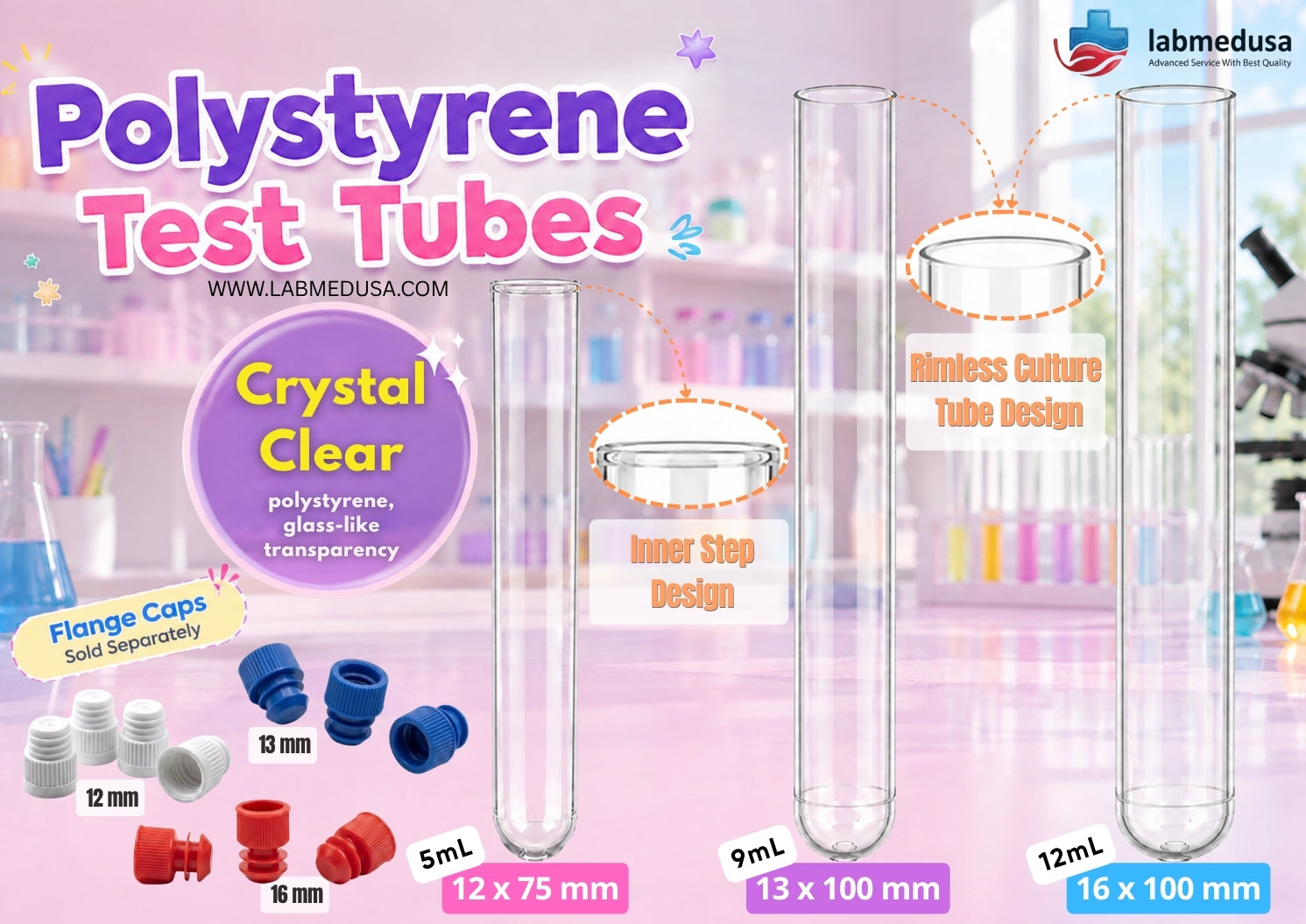
The three sizes in this collection feature a round-bottom or U-shaped bottom. This design is commonly used for sample collection, mixing, and other laboratory workflows where a rounded tube bottom is preferred.
Comparing 5mL, 9mL, and 12mL Polystyrene Test Tubes
Although all three tubes are made from clear polystyrene and feature round bottoms, their dimensions and capacities make them suitable for different sample-volume requirements.
| Size | Capacity | Dimensions | Design |
|---|---|---|---|
| 5mL Test Tube | 5mL | 12 × 75 mm | Round bottom |
| 9mL Test Tube | 9mL | 13 × 100 mm | Rimless, round bottom |
| 12mL Test Tube | 12mL | 16 × 100 mm | Rimless, round bottom |
Selecting between these sizes depends primarily on the sample volume, available rack space, handling requirements, and laboratory workflow.
5mL Polystyrene Test Tubes - 12 × 75 mm
The 12 × 75 mm polystyrene test tube has a 5mL capacity and provides a compact option for laboratories working with smaller sample volumes.
Its high optical clarity supports easy visual observation, while the round-bottom design provides a practical shape for routine sample handling.
Common Applications for 5mL Test Tubes
The 5mL format can be suitable for applications such as:
-
Sample preparation
-
Clinical laboratory workflows
-
Flow cytometry-related sample handling
-
Educational laboratory activities
-
General testing procedures
-
Science demonstrations and events
This size can be particularly convenient when a smaller tube format is preferred.
9mL Polystyrene Test Tubes - 13 × 100 mm
The 13 × 100 mm polystyrene test tube provides a 9mL capacity in a taller format. Its clear construction allows users to observe the contents while the round bottom supports common sample handling workflows.
This model features a rimless design, meaning the top opening has a smooth edge rather than a pronounced rolled or reinforced rim.
What Does Rimless Mean?
A rimless test tube has a smooth tube opening without a distinct rolled lip around the top edge. The design can be useful for compatible plug closures and straightforward laboratory handling.
The 9mL tube is also plug-seal compatible.
Common Applications for 9mL Test Tubes
The 9mL format can be used for:
-
Laboratory sample handling
-
Sample collection
-
Research workflows
-
Educational laboratory work
-
Routine testing
-
Culture-related laboratory procedures
-
General specimen handling
Its 13 × 100 mm dimensions provide a useful balance between capacity and tube length for many laboratory setups.
12mL Polystyrene Test Tubes - 16 × 100 mm
The 16 × 100 mm polystyrene test tube offers the largest capacity in this collection at 12mL.
Its wider diameter provides additional sample capacity while maintaining a clear, transparent tube wall for sample observation.
Common Applications for 12mL Test Tubes
The 12mL format can be suitable for:
-
Sample handling
-
Laboratory testing
-
Research applications
-
Educational laboratory activities
-
Specimen preparation
-
General laboratory workflows
-
Routine sample storage
Like the 9mL model, the 12mL tube features a rimless design.
Understanding Test Tube Capacity vs. Working Volume
When selecting a laboratory test tube, it is important to distinguish between tube capacity and recommended working volume.
A 5mL, 9mL, or 12mL designation describes the tube's stated capacity. It does not necessarily mean every application should fill the tube completely.
The appropriate sample volume depends on the specific procedure, mixing requirements, handling method, and laboratory protocol being followed.
Always follow the applicable laboratory procedure and equipment instructions when determining how much sample to place in a tube.
Choosing the Right Polystyrene Test Tube Size
The easiest way to select the appropriate tube is to consider three factors: sample volume, tube dimensions, and application requirements.
Choose 5mL When You Need a Compact Tube
The 12 × 75 mm, 5mL test tube is a practical choice for smaller sample volumes and applications where a shorter tube is preferred.
Choose 9mL for a Versatile Mid-Size Option
The 13 × 100 mm, 9mL test tube provides additional capacity while maintaining a relatively narrow 13 mm diameter.
Choose 12mL When More Capacity Is Needed
The 16 × 100 mm, 12mL test tube offers the largest capacity of the three options and a wider 16 mm tube diameter.
The 5mL, 9mL and 12mL models are designed to be compatible with suitable plug-seal closures, which can be purchased separately.
If your workflow requires closed tubes, confirm that the selected plug or closure is compatible with the specific tube diameter and design before use.
Can Polystyrene Test Tubes Be Autoclaved?
These polystyrene test tubes are not suitable for autoclaving or high-temperature applications.
Polystyrene is different from heat-resistant laboratory plastics such as polypropylene. When selecting a plastic test tube for a particular procedure, consider the material's temperature limitations and the requirements of the laboratory protocol.
For high-temperature sterilization procedures, use laboratory containers specifically designed and rated for that purpose.
Polystyrene vs. Glass Test Tubes
A common question is whether polystyrene test tubes can replace glass test tubes.
The answer depends on the application.
Polystyrene offers several practical advantages, including:
-
Lightweight construction
-
High optical clarity
-
Reduced concern about glass breakage
-
Convenient disposable use
-
Practical handling for high-volume workflows
Glass, on the other hand, is commonly selected for applications requiring properties that polystyrene does not provide, including certain high-temperature procedures.
Therefore, the best material depends on the temperature, chemical compatibility, sterilization requirements, and laboratory procedure.
Common Uses for Clear Polystyrene Test Tubes
Because of their transparency and practical laboratory format, clear PS test tubes can be used across many settings.
Typical applications include:
-
Clinical laboratory sample handling
-
Research laboratory workflows
-
Educational science laboratories
-
Sample preparation
-
General laboratory testing
-
Specimen handling
-
Culture-related workflows
-
Science demonstrations
-
Industrial laboratory testing
The appropriate use depends on the specific laboratory procedure and product specifications.
Key Differences at a Glance
The three tube sizes provide a simple range for different sample-handling requirements:
- 5mL (12 × 75 mm): Compact format for smaller sample volumes.
- 9mL (13 × 100 mm): Mid-size format offering additional capacity with a narrow tube diameter.
- 12mL (16 × 100 mm): Larger-capacity format with a wider tube diameter.
All three offer clear polystyrene construction and round-bottom designs, while the 9mL and 12mL models feature rimless openings .
Final Guide: Which Test Tube Should You Choose?
Choosing the right polystyrene laboratory test tube starts with your required capacity and tube dimensions.
For smaller sample volumes, the 5mL 12 × 75 mm test tube provides a compact option. For a mid-range capacity, the 9mL 13 × 100 mm test tube offers a taller, narrow format. When additional capacity is preferred, the 12mL 16 × 100 mm test tube provides the largest option in this collection.
With high optical clarity, transparent polystyrene construction, round-bottom designs, and practical laboratory dimensions, these test tubes provide versatile options for routine sample handling, research, education, testing, and general laboratory workflows.
Always review the product specifications and applicable laboratory procedures to ensure the selected test tube is appropriate for your intended application.
LabMedUSA, Medical and Laboratory Equipment Supplies in California, USA



Leave a comment