



Medical Specimen Transport Bags: What to Look For in an Insulated Cooler Tote
When a specimen, sample, or collection kit needs to move from one location to another, the bag carrying it matters more than it may first appear.
A good medical specimen transport bag is not simply a small cooler. It needs to help organize tubes, vials, cold packs, paperwork, and accessories while being practical enough for repeated movement between a clinic, vehicle, laboratory, hospital, or field location.
For mobile phlebotomists, laboratory couriers, pathology teams, veterinary clinics, home health professionals, and research staff, choosing the right insulated specimen transport bag can make everyday routes easier and more organized.
This guide explains the features worth looking for and how a compact insulated biohazard cooler tote can fit into different specimen transport workflows.
What Is a Medical Specimen Transport Bag?
A medical specimen transport bag is a portable carrier designed to help professionals move specimen containers and related supplies between locations.
Depending on the workflow, that may include:
-
Blood collection tubes
-
Vacutainer tubes
-
Urine specimen cups
-
Swabs
-
Vials
-
Small sample containers
-
Cold packs
-
Labels and requisition forms
-
Gloves and other small accessories
The goal is not simply to carry everything. A well-designed specimen transport bag helps keep the contents organized and makes frequently used items easier to access.
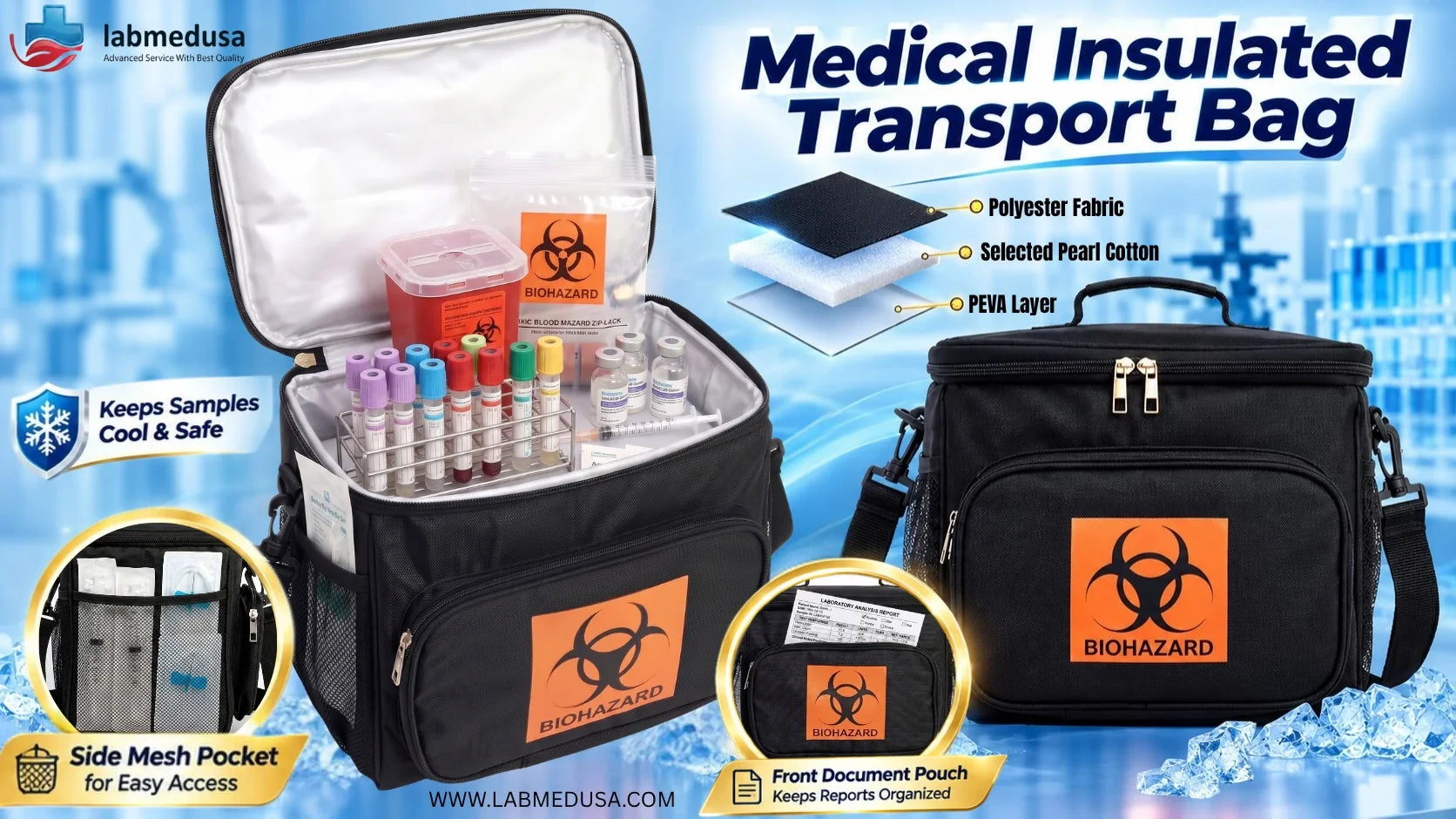
The carrier described in the product information uses a 9 × 5.5 × 7 inch compact footprint, with a top zippered main compartment, an adjustable interior divider, and a front zippered accessory pocket.
That combination is particularly useful when space is limited and the person carrying the bag needs to move quickly between stops.
Why Insulation Matters for Specimen Transport
One of the most important differences between an ordinary carrying bag and an insulated medical bag is the interior construction.
An insulated carrier can help reduce heat transfer between the inside and outside of the bag. The product uses a PEVA foil-lined interior backed by an EPE foam thermal layer and is designed to help slow heat transfer when used with reusable cold packs.
This makes the bag useful for workflows where certain items are transported alongside reusable cold packs.
It is important, however, to distinguish between insulation and a guaranteed temperature-controlled transport system. An insulated bag does not automatically provide a specific internal temperature for a specified number of hours. Actual temperature control depends on factors such as the contents, cold-pack configuration, starting temperature, ambient conditions, and transport time.
Why a Front-Compartment Design Is Useful
One of the biggest everyday problems with specimen transport is organization.
Imagine opening a bag and finding paperwork underneath tubes, cold packs mixed with accessories, and labels buried at the bottom. Even when the bag has enough room, poor organization can make a simple pickup more frustrating.
A Front-compartment specimen carrier addresses this by separating different types of items.
Main compartment
The top-loading compartment opens with a heavy-duty zipper and includes a movable interior divider. The divider can help create separate zones for tubes, vials, and cold packs.
Front accessory pocket
A separate front zippered pocket provides space for items such as requisition forms, labels, gloves, and other small accessories.
This separation can help create a more efficient workflow:
Specimens stay in the main compartment.
Paperwork and small accessories stay in the front pocket.
For professionals moving between multiple locations, that simple distinction can make the bag much easier to use.
What Should You Look For in an Insulated Specimen Transport Bag?
Not every laboratory or clinical route requires the same carrier. Before purchasing an insulated specimen carrier bag, consider these factors.
1. Size
A bag that is too large can become bulky when carried between multiple stops. A bag that is too small may leave little room for the items you actually need.
The carrier measures 9 × 5.5 × 7 inches, making it a compact option for smaller-volume routes and grab-and-go transport.
Its compact shape can also fit conveniently on a car seat, lab cart, workstation shelf, or other limited workspace.
2. Insulated construction
For users searching for a foil lined specimen transport tote, inspect what is actually inside the bag.
The carrier combines:
-
600D Oxford polyester exterior
-
PEVA foil-look lining
-
EPE foam thermal layer
-
Reusable cold-pack compatibility
This type of layered construction is useful for workflows where insulation is part of the transport setup.
3. Durability
A specimen carrier may be picked up, placed in a vehicle, moved onto a cart, opened repeatedly, and handled throughout the day.
The outer shell uses 600D Oxford polyester, with reinforced webbing handles, a top grab loop, and heavy-duty nylon zippers.
For frequent route work, details such as reinforced handles and durable zipper construction can be more important than appearance alone.
Who Can Use an Insulated Specimen Carrier?
An insulated lab specimen carrier can be useful across many different work environments.
Mobile phlebotomy
Mobile phlebotomists may travel between patient homes and collection locations while carrying tubes, collection supplies, accessories, and paperwork.
A compact insulated bag can help keep these items together during multi-stop routes.
Clinical laboratory courier routes
A clinical specimen courier tote bag can help organize specimen tubes, urine cups, swabs, and requisition paperwork during scheduled pickups between clinics and laboratories.
Hospital specimen transport
Hospital teams may need to move collection tubes, sample bottles, or culture-related materials between drawing areas and internal laboratories.
A compact handheld carrier can be easier to manage than a large transport container when the route involves multiple indoor stops.
Pathology and diagnostic laboratories
Pathology and diagnostic teams may transport specimen containers, slides, and vials between collection sites and laboratory locations.
The adjustable compartment can help organize different container types within one compact carrier.
Veterinary clinics
A veterinary specimen transport bag can be used to carry items such as blood tubes, swabs, fecal samples, and biopsy containers between examination areas, in-house laboratories, and external pickup points.
Home health and visiting professionals
Professionals making multiple home visits may appreciate a carrier that is compact enough to move easily from a vehicle to a residence.
The front accessory pocket can also provide a convenient place for paperwork and small supplies.
Research and field sampling
Research teams, environmental technicians, and field sampling crews can use an insulated tote to organize tubes, vials, and sample containers while moving between collection points and laboratory facilities.
How to Pack a Specimen Transport Cooler Bag
The way a bag is packed can be just as important as the bag itself.
Start by deciding what belongs in the primary compartment and what should remain outside the specimen area.
A practical organization approach is:
Main compartment: specimen containers, tubes, vials, and reusable cold packs.
Front pocket: paperwork, labels, gloves, and other small accessories.
When using cold packs, position them according to the requirements of the specific transport workflow and the materials being carried.
Avoid overpacking the carrier simply because additional space is available. A compact, organized load is generally easier to inspect, handle, and access than a crowded bag.
A Compact Alternative to Oversized Transport Cases
Not every route requires a large specimen cooler.
For smaller-volume pickups, a compact lab sample transport tote can be easier to carry and store.
At approximately 0.85 lb empty, the bag is lightweight while still providing a structured insulated interior and separate accessory storage.
Its 9 × 5.5 × 7 inch footprint also makes it practical for vehicle transport, laboratory workstations, and mobile routes where storage space is limited.
Common Mistakes When Choosing a Specimen Transport Bag
Buying a bag that is too large
More space is not always better. Oversized carriers can become cumbersome for short routes or mobile workflows.
Consider your typical specimen volume before choosing a size.
Ignoring the accessory pocket
Paperwork and labels are part of many specimen transport workflows. A dedicated pocket can keep these materials separate from specimen containers.
Final Thoughts
The right medical specimen transport bag does more than carry samples from Point A to Point B.
It can help create a better workflow by keeping specimen containers organized, separating paperwork from the main compartment, providing an insulated interior for use with cold packs, and remaining compact enough for everyday clinic, courier, vehicle, and field use.
For smaller-volume routes, mobile phlebotomy, clinic-to-lab transfers, veterinary sample transport, research collection, and similar applications, a compact insulated specimen carrier can provide a practical balance between organization, portability, and insulation.
When comparing options, focus on the details that matter during real-world use: dimensions, internal organization, insulation materials, durability, cleaning, compartment layout, and compatibility with your transport workflow.
The best transport bag is not necessarily the biggest one. It is the one that fits the way your team actually works.
Watch the bag details here: https://www.youtube.com/watch?v=UovyXBINOno



Leave a comment