



Butterfly Needle Gauge Guide: 18G to 27G Sizes, Uses, and Benefits
Butterfly needles, also called winged infusion sets or winged blood collection sets, are used for venipuncture, blood collection, and some IV therapy applications. Their flexible wings help improve handling and vein access, and many modern versions include safety features designed to help reduce needlestick injuries.
Understanding butterfly needle gauges matters because gauge number and needle diameter move in opposite directions: the higher the gauge, the smaller the needle diameter. In practical terms, lower gauges support faster flow, while higher gauges are thinner and are often preferred when comfort or fragile veins are a priority.
What butterfly needle gauges mean
In butterfly needles, the gauge tells you how wide the bore is. Across product lines, butterfly sets are commonly offered in a wide range such as 18G, 19G, 21G, 22G, 23G, 25G, and 27G, with 21G and 23G often used as common everyday choices.

A simple way to remember it is this: 18G and 19G are larger needles, 21G to 23G are balanced middle options, and 25G to 27G are slimmer needles for more delicate access. That is why the right gauge depends on the vein, the procedure, and how much flow you need.
18G butterfly needle: largest flow option
The 18G butterfly needle is one of the largest options in the butterfly range. Because lower gauge numbers mean larger diameters, 18G is generally chosen when higher flow is important and the vein can support it. In product lines that include 18G, it sits at the high-flow end of the butterfly family.
Best for: rapid collection needs, larger veins, and situations where flow matters more than needle slimness. In educational terms, 18G is the “power flow” option of the butterfly needle family.
19G butterfly needle: strong flow with a bit more flexibility
The 19G butterfly needle is still a relatively large needle, but slightly slimmer than 18G. It is often used when the clinician wants strong flow but may prefer a little more flexibility than the largest option.
Best for: larger, healthy veins and high-flow collection needs. Because it remains on the large side of the gauge range, 19G is not usually the first choice for very small or fragile veins.
21G butterfly needle: classic routine choice
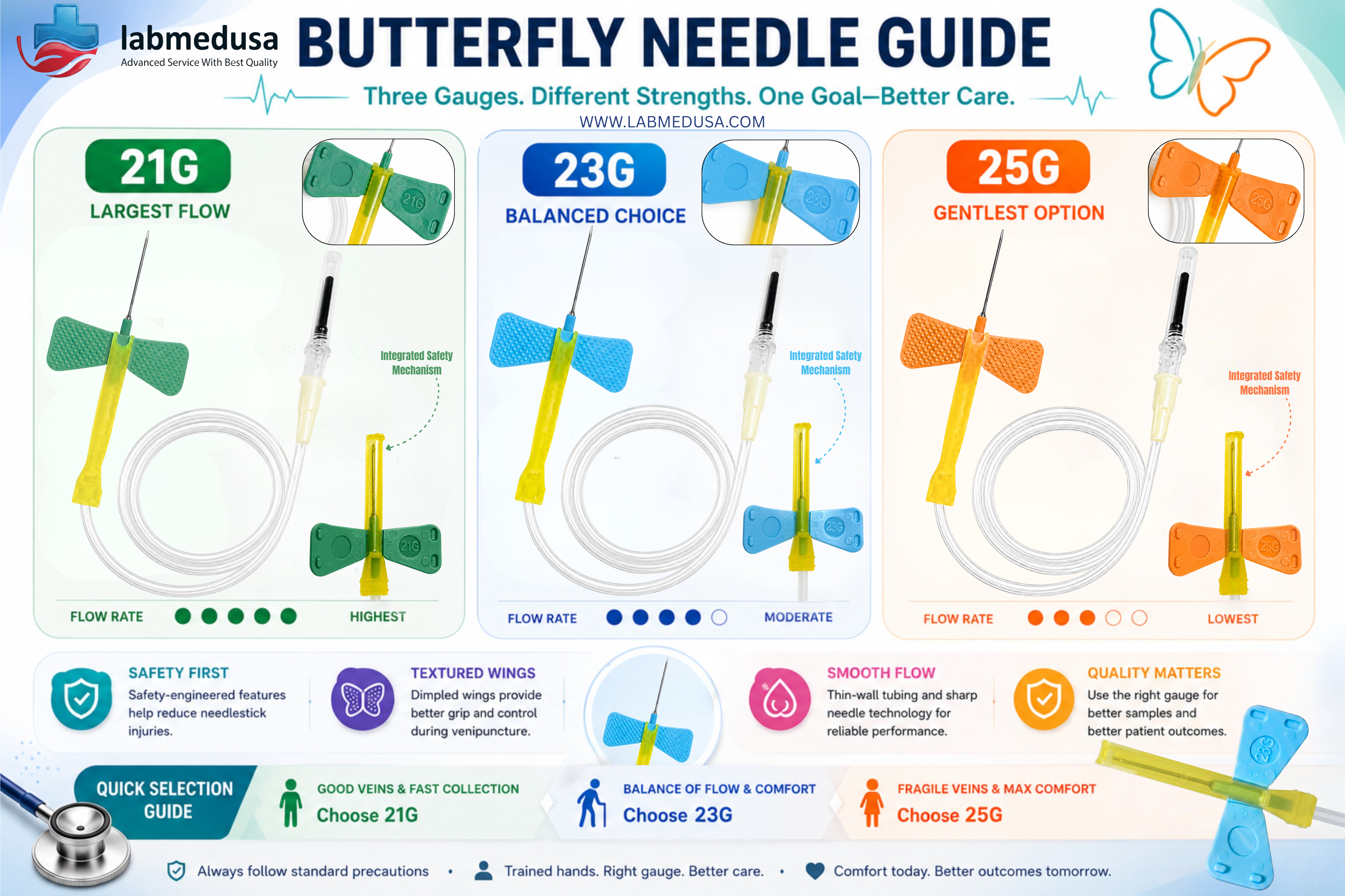
The 21G butterfly needle is one of the most widely used butterfly sizes in blood collection products. Major manufacturers list 21G as a standard option, and it is commonly positioned as a routine blood collection size because it balances flow and control well.
Best for: routine venipuncture, blood donation, blood collection, and patients with generally good veins. 21G is the needle size many people think of as the “standard butterfly needle.”
22G butterfly needle: middle-ground option
The 22G butterfly needle sits between 21G and 23G. It is a useful middle option when you want a little less diameter than 21G but not as slim as 23G.
Best for: general blood collection and IV therapy use cases where the vein is smaller than average but still allows decent flow.
23G butterfly needle: balanced comfort and flow
The 23G butterfly needle is another very common choice and is often used as a balanced option. It is smaller than 21G, so it can be a better fit when the vein is a little more delicate, while still preserving practical flow for routine collection.
Best for: routine blood draws, smaller veins, elderly patients, and situations where the clinician wants a good compromise between flow and comfort. In many educational comparisons, 23G is the “balanced choice” of butterfly needles.
24G butterfly needle: gentler access for fragile veins
The 24G butterfly needle is slimmer, making it more suitable for more delicate access. Smaller gauge needles can be useful when the vein is fragile or difficult to access and when a gentler touch is preferred.
Best for: pediatric patients, fragile veins, and IV medication situations where the vein and access site require extra care.
25G butterfly needle: slim, gentle, and patient-friendly
The 25G butterfly needle is one of the most important sizes because it is widely used for small, fragile, and hard-to-access veins. 25G butterfly set is specifically positioned to help improve success in complex venous access, reduce perceived pain, and maintain efficiency and specimen quality.
Best for: pediatrics, geriatrics, oncology, difficult venous access, and patients who need a gentler option. 25G is the slim, comfort-focused butterfly needle size.
26G butterfly needle: very fine access
The 26G butterfly needle is even slimmer and is used when access needs to be especially delicate. Product lines that include 26G and 27G position them for more specialized or fragile-vein applications rather than everyday routine draws.
Best for: neonatal or extremely fragile veins and other highly delicate access situations.
27G butterfly needle: smallest and most specialized
The 27G butterfly needle is the smallest common butterfly size in many product lines. It is intended for very delicate venous access, where the priority is precision and gentleness rather than speed.
Best for: neonates, very fragile veins, and specialty procedures. Because it is the slimmest option, it is usually selected only when the vein and clinical situation truly call for it.
How to choose the right butterfly needle gauge
A practical selection rule is simple: choose the largest gauge that still gives adequate flow and a comfortable, stable draw. Lower gauges are better when flow is the priority, while higher gauges are better when vein preservation and patient comfort matter more. Clinical judgment, patient factors, and the procedure itself should guide the final choice.
In short, 18G and 19G are for stronger flow, 21G and 23G are the everyday workhorses, and 25G to 27G are the slim options for fragile veins and delicate access.
| Gauge | Outer Diameter (Approx.) | Blood Flow | Common Uses | Recommended For |
|---|---|---|---|---|
| 18G | 1.27 mm | Highest | Rapid IV fluids, blood transfusions, contrast injection | Trauma, emergency care, surgery |
| 19G | 1.07 mm | Very High | High-flow IV therapy, blood transfusion | Large, healthy veins |
| 21G | 0.82 mm | High | Routine venipuncture, blood donation, blood collection | Most healthy adults |
| 22G | 0.72 mm | Moderate-High | General blood collection and IV therapy | Adults with smaller veins |
| 23G | 0.64 mm | Moderate | Difficult blood draws | Elderly, women, smaller veins |
| 24G | 0.56 mm | Low | IV medications and pediatric patients | Children and fragile veins |
| 25G | 0.51 mm | Lower | Small veins, superficial veins | Pediatrics, geriatrics |
| 26G | 0.46 mm | Very Low | Neonatal or extremely fragile veins | NICU, infants |
| 27G | 0.41 mm | Lowest | Very delicate venous access, specialty procedures | Neonates, cosmetic medicine, very fragile veins |
Butterfly needle features that matter most
Butterfly sets are not just about gauge. Their wings improve grip and control, the short needle and shallow angle help with superficial veins, and the soft tubing allows more freedom of movement during collection. Safety-engineered versions also help protect healthcare workers from needlestick injuries.
That is why butterfly needles are so popular in blood collection: they combine precision, comfort, and control in one compact device. For patients with small or rolling veins, that design can make the difference between a difficult stick and a successful draw.
Find the 21G Butterfly Needle Here
Find the 23G Butterfly Needle Here
Find the 25G Butterfly Needle Here
LabMedUSA, Laboratory and Medical Equipment Supplier in California, USA



Leave a comment