



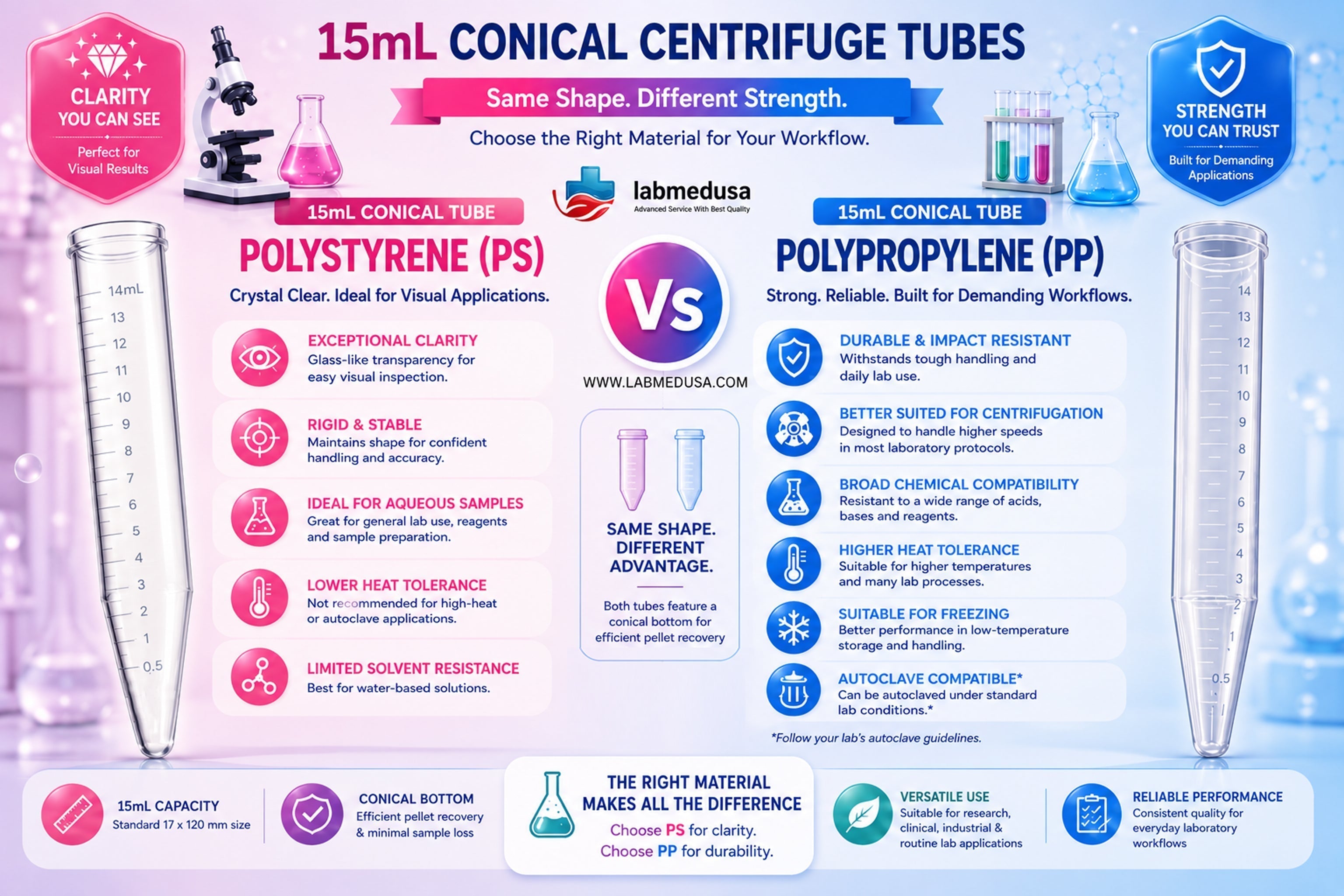
15mL Conical Tubes: Understanding the Difference Between Polystyrene (PS) and Polypropylene (PP)
Choosing the right 15mL conical tube is not simply about capacity or shape. Two tubes may look almost identical, yet the plastic material can significantly influence their clarity, durability, chemical compatibility, temperature tolerance, and suitability for different laboratory workflows.
The two commonly used materials are Polystyrene (PS) and Polypropylene (PP). Understanding the practical differences between these materials can help laboratories select the appropriate 15mL conical tube for sample preparation, liquid handling, centrifugation, research, education, and routine laboratory work.
What Is a 15mL Conical Centrifuge Tube?
A 15mL conical centrifuge tube is a laboratory tube designed to hold and process liquid samples. Its cylindrical upper section and tapered, conical bottom provide a practical format for sample handling and, when the specific tube is rated for it, centrifugation.
The exact dimensions, maximum centrifugation speed, temperature range, chemical compatibility, and closure compatibility depend on the specific product and manufacturer.
PS vs PP: Why Does the Material Matter?
The biggest difference between a polystyrene centrifuge tube and a polypropylene conical tube comes from the inherent properties of the plastics.
Polystyrene (PS)
Polystyrene is known for its high optical clarity and rigidity. Clear PS laboratory tubes can provide excellent visibility of samples, making it easier to observe liquid levels, colors, suspended material, or other visual characteristics.
Polypropylene (PP)
Polypropylene is known for its combination of durability, chemical resistance, and higher temperature tolerance compared with many other common laboratory plastics. These characteristics make PP a versatile material for a wide range of laboratory applications.
Neither material is automatically "better" for every application. The better choice depends on what the laboratory needs the tube to do.
1. Polystyrene 15mL Conical Tubes: Clarity Comes First
15mL high-clarity polystyrene tubes are particularly useful when visual inspection is an important part of the workflow.
The transparent nature of PS can make it easier to observe:
- Sample volume
- Sample color
- Liquid interfaces
- Suspended material
- General sample appearance
- Contents during routine handling
This makes PS conical tubes useful for general laboratory sample preparation, educational experiments, liquid handling, reagent distribution, and applications where optical visibility is important.
Key advantages of PS
-
Excellent optical clarity
Clear polystyrene can provide glass-like visual transparency, allowing users to easily inspect tube contents. -
Rigid structure
PS provides a relatively rigid tube structure that can be useful during routine handling. -
Easy sample identification
Clear walls combined with printed graduations can help users quickly assess samples and approximate volumes. -
Important consideration
Polystyrene generally has lower heat tolerance and more limited solvent resistance than polypropylene. It should therefore not automatically be selected for high-temperature, autoclave, or aggressive-solvent applications.
Always check the specific tube's technical specifications before use.
2. Polypropylene 15mL Conical Tubes: A More Versatile Material
Polypropylene (PP) 15mL conical tubes are widely used when laboratories need a balance of durability, chemical compatibility, and temperature tolerance.
PP can be suitable for workflows involving:
- Sample preparation
- Centrifugation, when the tube is appropriately rated
- Cell biology workflows
- Microbiology applications
- Chemical and reagent handling
- Clinical laboratory workflows
- Research applications
- Low-temperature sample handling
Key advantages of PP
-
Good chemical compatibility
Polypropylene generally offers good resistance to many commonly encountered laboratory solutions, including various aqueous buffers, biological media, acids, bases, and laboratory reagents.
However, chemical compatibility is substance- and concentration-dependent. Always consult the manufacturer's compatibility information for specific chemicals. -
Higher temperature tolerance
PP generally tolerates higher temperatures than PS, making it more suitable for certain temperature-sensitive laboratory processes. -
Good impact resistance
Compared with PS, polypropylene is generally less brittle and better suited to routine handling where greater toughness is desirable. -
Suitable for demanding workflows
When a specific PP tube has been validated for centrifugation, freezing, or autoclaving, its material characteristics can make it suitable for these applications.
Why Does the Conical Bottom Matter?
Both PS and PP 15mL conical tubes can use a tapered bottom.
The conical shape helps direct material toward a smaller area at the bottom of the tube. During appropriate centrifugation procedures, this geometry can help concentrate pelleted material and make sample recovery easier.
The conical design can also be useful during:
- Sample preparation
- Sediment collection
- Cell processing
- Liquid transfer
- Decanting
- Pellet recovery
However, the actual recovery performance depends on the sample, centrifugation conditions, tube geometry, and laboratory protocol.
Choosing PS or PP: Which One Should You Use?
A simple way to think about the choice is:
Choose PS when:
🔍 Optical clarity is your priority.
PS can be a practical choice when you need excellent visibility of the sample and primarily perform routine aqueous sample handling or visual inspection.
Choose PP when:
💪 Durability and versatility are more important.
PP may be a better material choice when your workflow involves greater mechanical handling, broader chemical exposure, higher temperatures, freezing, or centrifugation, provided the specific tube is rated for those conditions.
Common Applications for 15mL Conical Tubes
Depending on the tube material and product specifications, 15mL conical tubes can be used across a variety of laboratory environments.
-
Research Laboratories
Useful for sample preparation, liquid handling, cell and molecular biology workflows, and general laboratory processing. -
Clinical & Diagnostic Laboratories
Clear conical tubes can provide convenient sample visibility and organized sample handling when the specific tube is appropriate for the intended procedure. -
Educational Laboratories
15mL tubes are convenient for teaching demonstrations, STEM activities, basic experiments, and sample preparation. -
Industrial Laboratories
Conical tubes can support reagent distribution, sample processing, testing, and routine analytical workflows. -
General Laboratory Use
Their compact size, graduated markings, and conical design make 15mL tubes useful for many everyday liquid-handling tasks.
Frequently Asked Questions
Is PP always better than PS?
No. PP and PS are optimized for different material properties. PS offers excellent optical clarity, while PP generally provides greater durability, chemical resistance, and temperature tolerance.
Can PS tubes be autoclaved?
PS is generally not the preferred material for autoclaving because of its lower heat tolerance. Always follow the manufacturer's instructions.
Can PP tubes be autoclaved?
Some PP laboratory tubes are designed and validated for autoclaving, but not every PP tube is automatically autoclavable. Check the manufacturer's specifications before autoclaving.
Which is clearer, PS or PP?
In general, polystyrene provides higher optical clarity than polypropylene, making PS particularly attractive when visual inspection is important.
Final Takeaway: PS vs PP Is About Choosing the Right Material
When selecting a 15mL conical centrifuge tube, the most important question is not simply "PS or PP which is better?"
Instead, ask:
What does my laboratory workflow require?
If your priority is high optical clarity and easy visual inspection, a 15mL polystyrene conical tube can be a practical choice.
If your priority is durability, chemical compatibility, temperature tolerance, and broader laboratory versatility, a 15mL polypropylene conical tube may be more appropriate.
Both materials can provide useful solutions for laboratory sample handling, but product-specific specifications should always be checked before centrifugation, freezing, heating, autoclaving, or exposure to chemicals.
The simple rule:
PS → Clarity-focused workflows 🔍
PP → Durability-focused workflows 💪
The right tube is the one whose material properties and validated specifications match your sample, equipment, and laboratory process.
Find the 15ml Polystyrene (PS) Conical Liquid Handling Tubes here:
https://labmedusa.com/products/15ml-polystyrene-ps-conical-tube
Find the 15ml Polypropylene (PP) Conical Centrifuge Tubes here:
https://labmedusa.com/products/15ml-polypropylene-pp-conical-centrifuge-tube
LabMedUSA, Medical and Laboratory Supplies in California, USA



Leave a comment