



1000µL Universal Filter Pipette Tips: A Practical Guide to Aerosol Barrier Tips, Low-Retention Pipetting, and Reliable Liquid Handling
Why 1000µL Filter Pipette Tips Matter in Modern Laboratories
Accurate liquid handling is one of the foundations of reliable laboratory work. From molecular biology and PCR preparation to clinical research, microbiology, biotechnology, quality control, and routine sample preparation, the pipette tip is the direct interface between the pipette and the liquid being transferred.
The right 1000µL universal filter pipette tip can provide more than simple liquid transfer. An aerosol barrier helps create a physical separation between the sample and pipette shaft, while a low-retention inner surface can help reduce residual liquid left behind in the tip.
This makes 1000µL aerosol barrier pipette tips a practical choice for laboratories that regularly handle aqueous solutions, reagents, biological samples, and other liquids where contamination control and consistent liquid transfer are important.
What Are 1000µL Universal Filter Pipette Tips?
A 1000µL pipette tip, also called a 1000µL micropipette tip, 1mL pipette tip, or 1000 microliter pipette tip, is designed for liquid-handling applications up to 1 mL, depending on the pipette and operating range.
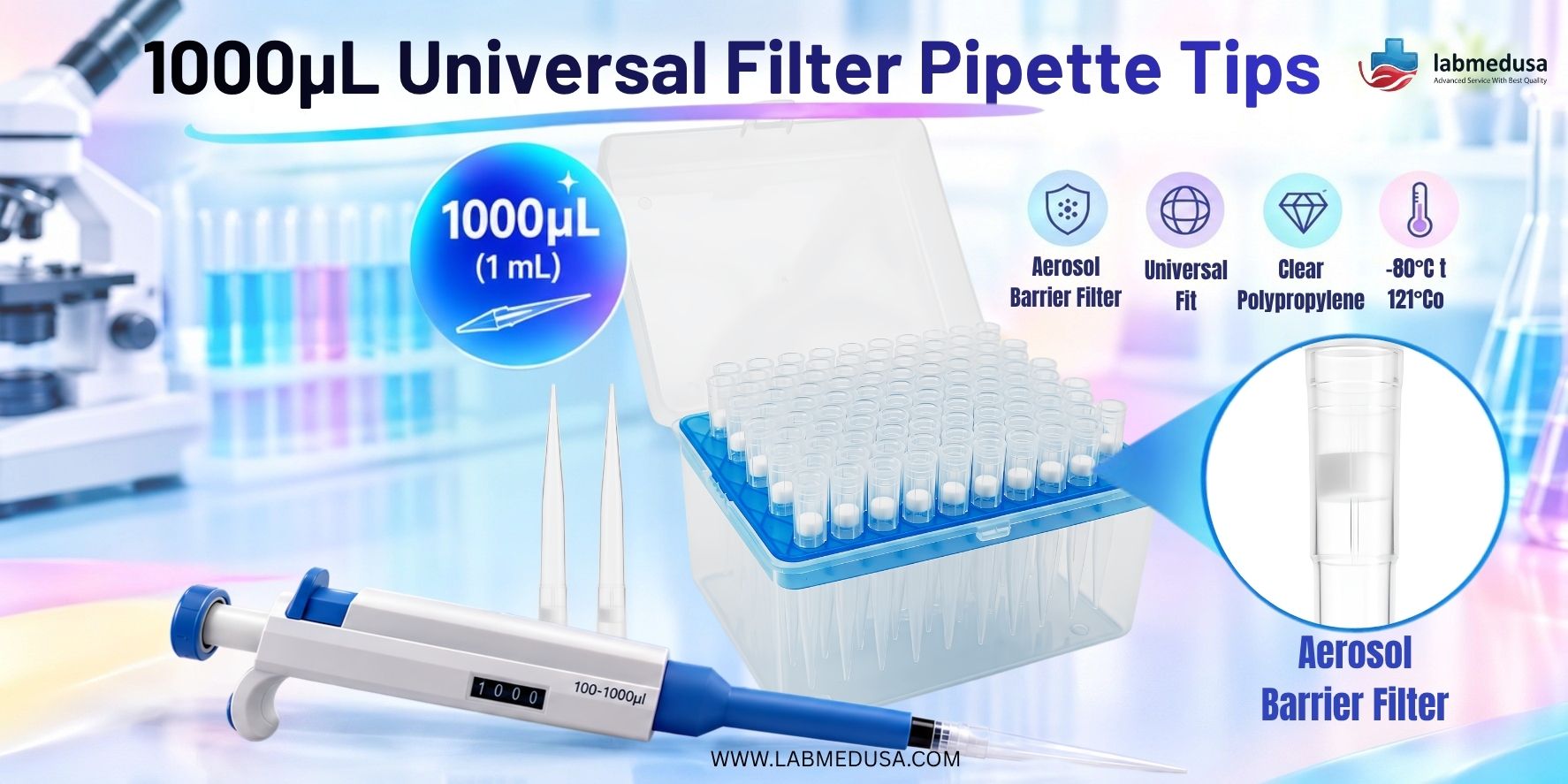
This product uses a clear polypropylene (PP) construction and incorporates an internal aerosol barrier filter. The tip has an approximate size of 8 mm × 71 mm (0.31 × 2.80 inches) and is supplied in racks for convenient bench use.
The universal-fit design is intended to work with a broad range of compatible single-channel and multi-channel micropipettes. Proper fit is important because the pipette and tip work together as a system: an appropriate seal helps the pipette operate correctly and reduces the possibility of air leakage during aspiration and dispensing. Pipetting performance depends on the compatibility and fit between the pipette and tip.
Key Specifications
-
Capacity: 1000µL (1mL)
-
Material: Clear polypropylene (PP)
-
Tip dimensions: 8 mm × 71 mm
-
Filter: Integrated aerosol barrier
-
Temperature rating: -80°C to 121°C
-
Purity specification: RNase-free, DNase-free, pyrogen-safe
-
Format: Pre-loaded hinged racks
-
Tip style: Universal fit
-
Surface: Low-retention smooth inner wall
How Does an Aerosol Barrier Filter Work?
During pipetting, rapid aspiration and dispensing can generate droplets, splashes, and aerosols. Under certain conditions, these contaminants can reach the pipette shaft and potentially contribute to carryover contamination.
A filter pipette tip places a barrier inside the tip between the liquid sample and the pipette. The purpose is to reduce the opportunity for aerosols or liquid to reach the pipettor.
Published laboratory evaluations have demonstrated why filtered and barrier-style tips are commonly used when contamination is a concern. Thermo Fisher, for example, describes filtered tips as useful for protecting pipettes and samples from contamination, while its barrier-tip studies examine protection against aerosol and liquid carryover.
This is particularly relevant for workflows where sample-to-sample contamination could compromise downstream results.
Why the aerosol barrier is useful
An aerosol barrier can help:
-
Reduce the risk of contamination reaching the pipette shaft
-
Reduce potential carryover between samples
-
Support cleaner liquid-handling workflows
-
Protect frequently used pipetting equipment
-
Provide an additional layer of contamination control
It is important to remember that a filtered pipette tip is only one part of contamination control. Good laboratory technique, appropriate pipette handling, clean work surfaces, and proper consumable changes remain essential.
Filtered Tips vs. Non-Filtered Pipette Tips
The primary difference is the presence of a filter or barrier within the tip.
A standard non-filtered pipette tip provides a direct pathway between the sample and pipette shaft. For routine liquids where contamination is not a major concern, non-filtered tips may be sufficient.
A filtered pipette tip adds an internal barrier designed to help reduce contamination of the pipette. This is why filtered tips are frequently selected for sensitive workflows such as molecular biology, PCR-related preparation, microbiology, clinical laboratory research, and other applications where aerosol contamination may be problematic.
What Does “Universal Fit” Mean?
Universal-fit pipette tips are designed to seat on a broad selection of compatible micropipettes rather than being restricted to a single pipette model.
For laboratories using different pipette brands or maintaining multiple pipetting stations, this can make consumable management easier. A universal design may also reduce the need to stock numerous tip geometries for different instruments.
However, “universal” does not mean that every tip will fit every pipette perfectly. The best performance still depends on the specific pipette, cone geometry, insertion force, sealing characteristics, and manufacturer compatibility.
A properly seated tip should form a secure connection without excessive force.
Why a good pipette-tip seal matters
An effective connection between the pipette and tip helps maintain the air-displacement system used during aspiration and dispensing. A poor connection can contribute to leakage, inconsistent aspiration, dripping, or reduced repeatability.
For this reason, laboratories should verify compatibility before adopting a universal pipette tip across a large fleet of pipettes.
What Is a Low-Retention Pipette Tip?
A low-retention pipette tip is designed to reduce the amount of liquid that adheres to the inside wall of the tip.
Traditional polypropylene surfaces can retain a small film of liquid, particularly when handling liquids with low surface tension. This residual volume may contribute to sample loss and variation in liquid delivery.
Research and manufacturer application data show that tip surface characteristics can influence residual liquid and sample recovery. Sartorius notes that low-retention technologies are intended to minimize liquid adhesion, but also emphasizes that “low retention” is not a standardized performance specification and that products can differ considerably.
For laboratories working with expensive reagents, small sample volumes, detergents, buffers, or other challenging liquids, a low-retention tip may therefore be worth considering.
Why Smooth Inner Walls Can Help Liquid Transfer
The inside surface of the pipette tip directly contacts the liquid during aspiration and dispensing.
A smooth, low-retention inner wall is designed to reduce liquid adhesion. This can be especially useful when the laboratory wants to minimize residual sample inside disposable tips.
However, tip geometry, pipetting technique, liquid properties, temperature, viscosity, and pipette settings all influence actual liquid transfer performance. A low-retention label should therefore be viewed as a design feature rather than a guarantee of perfect sample recovery in every application.
Why Polypropylene Is Commonly Used for Pipette Tips
Polypropylene (PP) laboratory plastic
Polypropylene is widely used for disposable laboratory consumables because it offers a useful combination of chemical resistance, clarity options, low weight, and suitability for many laboratory environments.
The supplied 1000µL universal filter pipette tips are made from clear laboratory-grade polypropylene and are specified for temperatures from -80°C to 121°C.
Polypropylene's chemical compatibility makes it useful for many routine laboratory liquids, but compatibility should always be evaluated for the exact chemical, concentration, exposure time, and temperature involved. A general material rating should not be treated as a blanket guarantee for every solvent or reagent.
RNase-Free and DNase-Free Pipette Tips
For molecular biology applications, nucleases are an important consideration.
RNase-free
RNases can degrade RNA and interfere with RNA-based workflows. Using consumables specified as RNase-free can help reduce one potential source of contamination.
DNase-free
DNases can degrade DNA and may interfere with molecular biology workflows involving nucleic acids. DNase-free consumables are designed to minimize this source of contamination.
The product is specified as RNase-free and DNase-free, making it suitable for laboratory workflows where nucleic-acid contamination control is important.
Pyrogen-safe
Pyrogens can be an important consideration in certain laboratory and biological applications. The product specification identifies these tips as pyrogen-safe, providing an additional consumable specification for laboratories with appropriate purity requirements.
The exact suitability of any consumable should always be determined according to the laboratory's own protocol, validation requirements, and application standards.
Common Applications for 1000µL Filter Pipette Tips
Molecular biology
Large-volume liquid handling is common when preparing buffers, reagents, dilution series, and biological samples. Filter tips can add contamination control when working with nucleic-acid-sensitive workflows.
PCR and molecular workflows
PCR workflows are particularly sensitive to contamination because unintended nucleic acids can affect downstream amplification. Filtered tips are commonly used in PCR-related workflows as part of broader contamination-control practices.
Cell culture and microbiology
Filtered pipette tips may be selected when laboratory procedures require additional protection against aerosol-related contamination. Manufacturer guidance identifies cell culture and microbiology among workflows where filtered tips may be useful.
Clinical and diagnostic research
Clinical research laboratories may use disposable filtered tips for sample preparation and routine liquid handling where contamination control is important.
Biotechnology and life science research
Biotechnology laboratories frequently handle buffers, media, reagents, enzymes, biological samples, and other research materials where consistent pipetting and clean consumables are important.
Quality control and testing laboratories
The 1000µL volume class is useful for transferring larger reagent volumes, preparing samples, performing dilutions, and supporting routine laboratory testing workflows.
Racked Pipette Tips: A Better Benchtop Workflow
These 1000µL filter tips come pre-loaded in hinged racks, which can simplify daily pipetting.
Instead of handling individual loose tips, the user can access a prepared rack, attach a tip directly to the pipette, and eject the used tip into the appropriate waste container.
Racked packaging can provide several practical advantages:
-
Faster tip loading
-
Reduced manual handling
-
Cleaner benchtop organization
-
Convenient storage between uses
-
Easier one-handed workflow
-
Simple access during repetitive pipetting
Racked filter tips are particularly convenient for laboratories performing many repeated liquid transfers throughout the day.
How to Choose the Right 1000µL Filter Pipette Tip
When selecting a 1000µL universal filter pipette tip, consider more than capacity alone.
1. Check pipette compatibility
Verify that the tip seats correctly on the specific single-channel or multi-channel pipette being used.
2. Decide whether filtration is necessary
Filter tips are particularly useful when aerosol or cross-contamination is a concern. For simple routine transfers, non-filtered tips may be adequate.
3. Consider liquid characteristics
Viscosity, surface tension, temperature, and chemical composition can affect pipetting performance. Low-retention tips may be beneficial for liquids that tend to adhere to conventional polypropylene surfaces.
4. Review purity requirements
For molecular biology and sensitive research, specifications such as RNase-free, DNase-free, and pyrogen-safe may be important.
5. Consider tip packaging
Racked tips can improve convenience and organization for laboratories that perform frequent pipetting.
6. Check dimensions
A 1000µL tip is not defined by volume alone. Physical dimensions can affect access to tubes, plates, reservoirs, and other laboratory vessels. This product measures approximately 8 mm × 71 mm.
1000µL Filter Pipette Tips vs. Standard Tips
The biggest difference is contamination control.
A standard pipette tip is primarily designed for liquid transfer. A 1000µL aerosol barrier filter pipette tip adds an internal filtering element intended to help reduce the movement of aerosols toward the pipette.
For workflows involving PCR, DNA, RNA, biological samples, microbiology, or other contamination-sensitive procedures, that additional barrier can be valuable.
The low-retention inner surface provides another practical feature by aiming to minimize liquid remaining on the tip wall.
Together, aerosol barrier filtration + universal fit + low-retention polypropylene + racked packaging make this type of tip a versatile option for routine laboratory liquid handling.
Product Specifications at a Glance
| Specification | Details |
|---|---|
| Product Type | Universal Filter Pipette Tips |
| Volume | 1000µL (1mL) |
| Material | Clear Polypropylene (PP) |
| Tip Size | 8 × 71 mm (0.31 × 2.80 in) |
| Filter | Aerosol Barrier |
| Inner Surface | Low-retention, smooth |
| Purity | RNase-free, DNase-free, pyrogen-safe |
| Temperature Rating | -80°C to 121°C |
| Format | Racked |
| Pipette Compatibility | Universal-fit design for compatible single- and multi-channel micropipettes |
Frequently Asked Questions About 1000µL Filter Pipette Tips
Are 1000µL pipette tips the same as 1mL pipette tips?
Yes. 1000µL is equivalent to 1mL. The terms 1000µL pipette tip, 1mL pipette tip, and 1000 microliter pipette tip are commonly used to describe the same capacity category.
What is an aerosol barrier pipette tip used for?
An aerosol barrier pipette tip is used to add a physical barrier between the sample and pipette shaft, helping reduce the risk of aerosol and liquid contamination reaching the pipette. Filter tips are commonly selected for contamination-sensitive laboratory workflows.
Are filter pipette tips useful for PCR?
They can be. PCR and other nucleic-acid workflows can be highly sensitive to carryover contamination, which is why filtered or barrier-style pipette tips are commonly used as part of contamination-control procedures.
What does low-retention mean on a pipette tip?
Low-retention means the tip is designed to reduce liquid adhesion to its inner surface. This can help reduce residual liquid and potential sample loss, although actual performance depends on the liquid and tip design.
Are polypropylene pipette tips chemically resistant?
Polypropylene is resistant to many laboratory chemicals, but resistance varies according to the specific chemical, concentration, temperature, and exposure time. Always consult an appropriate chemical compatibility guide before using a tip with aggressive chemicals.
Can these tips be used with multi-channel pipettes?
The product's universal-fit design is intended for compatible single-channel and multi-channel micropipettes. Always verify physical and performance compatibility with the specific pipette model before routine use.
The Takeaway: One Tip Designed for Everyday Laboratory Liquid Handling
A 1000µL Universal Filter Pipette Tip with Aerosol Barrier combines several practical features into one disposable laboratory consumable: 1mL capacity, universal-fit geometry, aerosol filtration, a low-retention polypropylene surface, contamination-conscious purity specifications, and convenient racked packaging.
For laboratories working with molecular biology, PCR preparation, microbiology, clinical research, biotechnology, quality control, and routine liquid handling, these features can help support a cleaner and more organized pipetting workflow.
Choosing the right 1000µL filter pipette tips is ultimately about matching the consumable to the application. When contamination control, sample recovery, pipette protection, and convenient workflow all matter, an aerosol barrier filter tip can be a practical addition to the laboratory bench.
LabMedUSA, Laboratory and Medical Supplies in Pomona, California



Leave a comment