



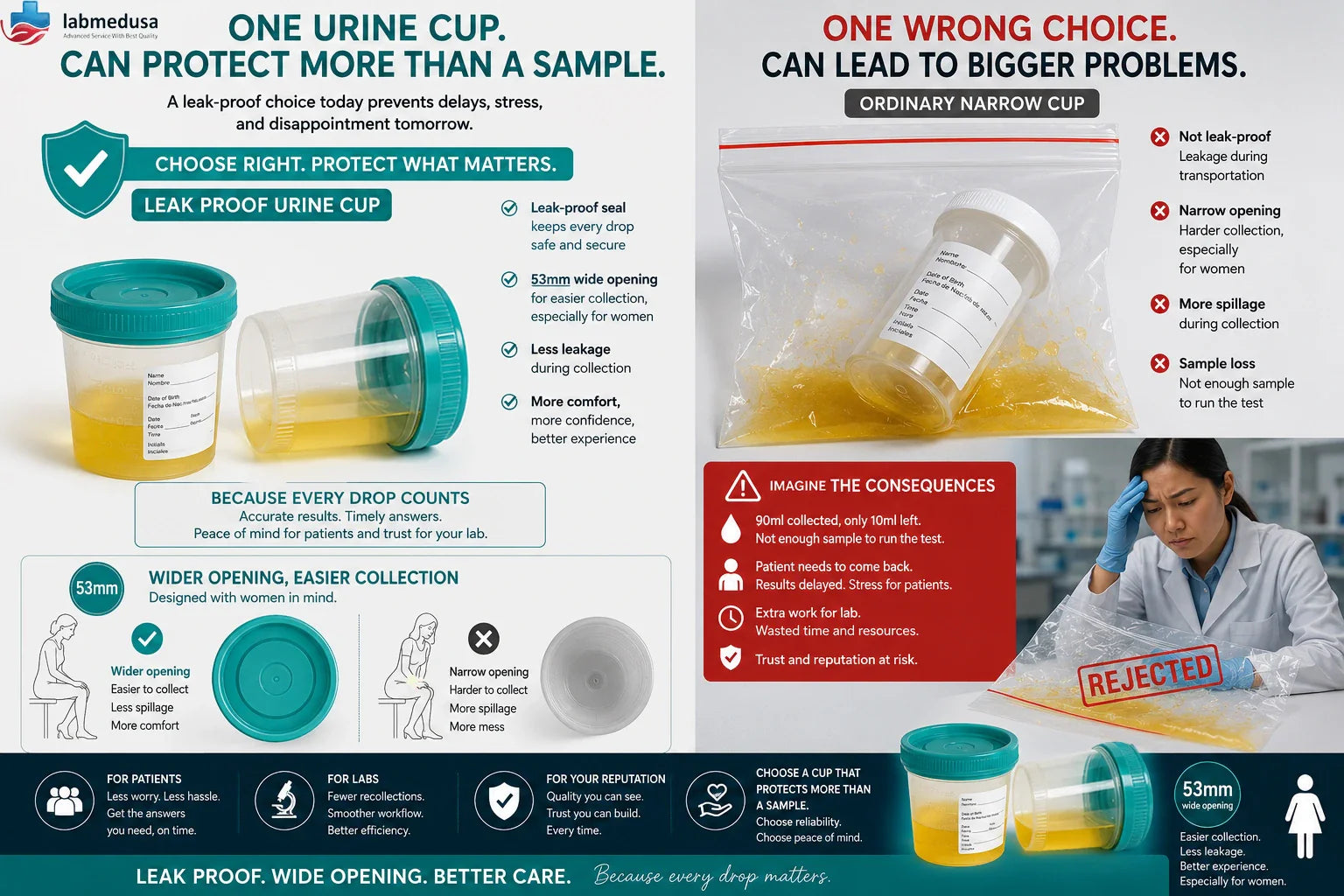
90 mL Collected, 10 mL Left. The Hidden Cost of Choosing the Wrong Urine Cup
A Small Medical Container With Big Consequences
A patient sits quietly in a clinic waiting room.
Maybe she's a mother worried about her health.
Maybe he's a job applicant waiting for medical clearance before starting a new career.
Maybe it's an elderly patient anxiously waiting for answers that could affect treatment decisions.
Like thousands of patients every day, they are asked to provide a urine sample.
They carefully follow instructions.
The specimen cup is filled.
The lid is closed.
The sample is labeled and sent to the laboratory.
Everything seems routine.
Everything seems normal.
Then something unexpected happens.
By the time the specimen reaches the laboratory, the cup has leaked.
The original 90 mL urine sample has become just 10 mL.
The laboratory technician examines the specimen and immediately recognizes the problem.
There isn't enough urine left to perform the required testing.
The result cannot be released.
The patient must return and provide another sample.
The waiting continues.
When a Leaking Urine Cup Delays More Than Just a Test
Most people think a urine cup is simply a container.
In reality, it is the first and one of the most critical links in the diagnostic testing process.
A leaking urine specimen container can create a chain reaction of problems:
For Patients
The consequences can be surprisingly significant.
Patients may need to:
-
Return to the clinic or laboratory.
-
Take additional time off work.
-
Arrange transportation again.
-
Delay treatment decisions.
-
Wait longer for important results.
Most importantly, they must continue living with uncertainty.
For someone waiting to know whether they have an infection, kidney condition, metabolic disorder, or other health concern, every additional day feels much longer.
For Healthcare Providers
Healthcare professionals depend on timely laboratory results to make informed decisions.
A delayed specimen can mean:
-
Delayed diagnosis
-
Delayed treatment
-
Additional patient follow-up
-
Increased administrative workload
Something as simple as a leaking specimen container can impact the efficiency of the entire healthcare process.
For Laboratories
Laboratories work hard to maintain quality standards, accuracy, and trust.
When a specimen arrives with insufficient volume due to leakage, laboratories often face:
-
Recollection requests
-
Additional labor costs
-
Workflow disruptions
-
Customer complaints
-
Reduced operational efficiency
Even if the leak originates from the container itself, patients may still associate the problem with the laboratory.
Trust takes years to build and only moments to lose.
Why Leak-Proof Urine Cups Matter
The purpose of a urine collection container is not merely to hold a specimen.
Its purpose is to protect it.
A high-quality leak-proof urine cup helps ensure:
Sample Integrity
The sample collected is the sample that arrives for testing.
No loss.
No contamination.
No compromise.
Accurate Laboratory Results
Adequate specimen volume is essential for many laboratory procedures.
A secure leak-proof design helps preserve enough urine for reliable testing.
Better Patient Experience
Patients expect a smooth and efficient testing process.
A reliable specimen cup reduces the likelihood of recollection and delays.
Improved Laboratory Efficiency
Fewer rejected samples mean:
-
Less administrative work
-
Fewer recollections
-
Faster turnaround times
-
Improved productivity
The Overlooked Feature That Makes Collection Easier: A 53 mm Wide Opening
Leak-proof protection is only part of the solution.
The collection experience itself also matters.
This is where many traditional urine cups fall short.
The Problem With Narrow Opening Urine Cups
A narrow specimen cup opening can make urine collection more difficult, especially for women.
Common challenges include:
-
Missed collection attempts
-
Spillage around the rim
-
Sample loss before the cup is even sealed
-
Increased discomfort and frustration
The result?
Less specimen volume.
More mess.
Poorer user experience.
Why a 53 mm Diameter Opening Makes a Difference
A urine cup with a 53 mm wide opening provides a larger collection area, making specimen collection significantly easier.
Benefits include:
Easier Collection for Women
The wider opening provides a larger target area, reducing the difficulty often associated with urine collection.
Less Spillage
More urine enters the cup instead of ending up on surrounding surfaces.
Better Hygiene
Reduced external contamination means cleaner handling for both patients and healthcare staff.
Improved Sample Volume
Less spillage means more specimen remains available for laboratory analysis.
Greater Patient Comfort
Patients feel more confident and comfortable throughout the collection process.
Every Drop Matters
When people think about healthcare innovation, they often imagine advanced diagnostic equipment or sophisticated laboratory analyzers.
Few think about the urine cup.
Yet this simple product carries something incredibly important:
A patient's answer.
The answer to whether treatment is needed.
The answer to whether a condition is improving.
The answer that may bring relief, reassurance, or a clear next step.
Protecting that answer begins with protecting the sample.
Choosing the Right Urine Collection Cup
When selecting a urine specimen container, healthcare facilities should prioritize:
-
Leak-proof sealing technology
-
Wide-mouth design
-
Sample preservation
-
Patient comfort
-
Laboratory efficiency
-
Reliable transportation performance
A high-quality leak-proof urine cup with a 53 mm wide opening addresses all of these requirements.
Conclusion: The Cheapest Cup Can Become the Most Expensive Mistake
A leaking urine cup may seem like a small problem.
But behind every leaked specimen is a patient waiting for answers.
Behind every recollection is additional cost, time, and frustration.
Behind every delayed result is a healthcare decision that cannot move forward.
The right urine cup does more than hold a sample.
It protects patients.
It supports laboratories.
It preserves trust.
And sometimes, it makes the difference between getting answers today or waiting for them tomorrow.
Because in diagnostic testing, every drop matters.



Leave a comment