



10 Mil Biohazard Nail Specimen Bags: A Guide to Small-Specimen Handling
Small specimens can create surprisingly large handling challenges. Nail clippings, extracted teeth, removed piercing jewelry, and other compact clinical items require clear identification, secure containment, and organized transport. Standard specimen bags may be unnecessarily large, making tiny items harder to see and manage.
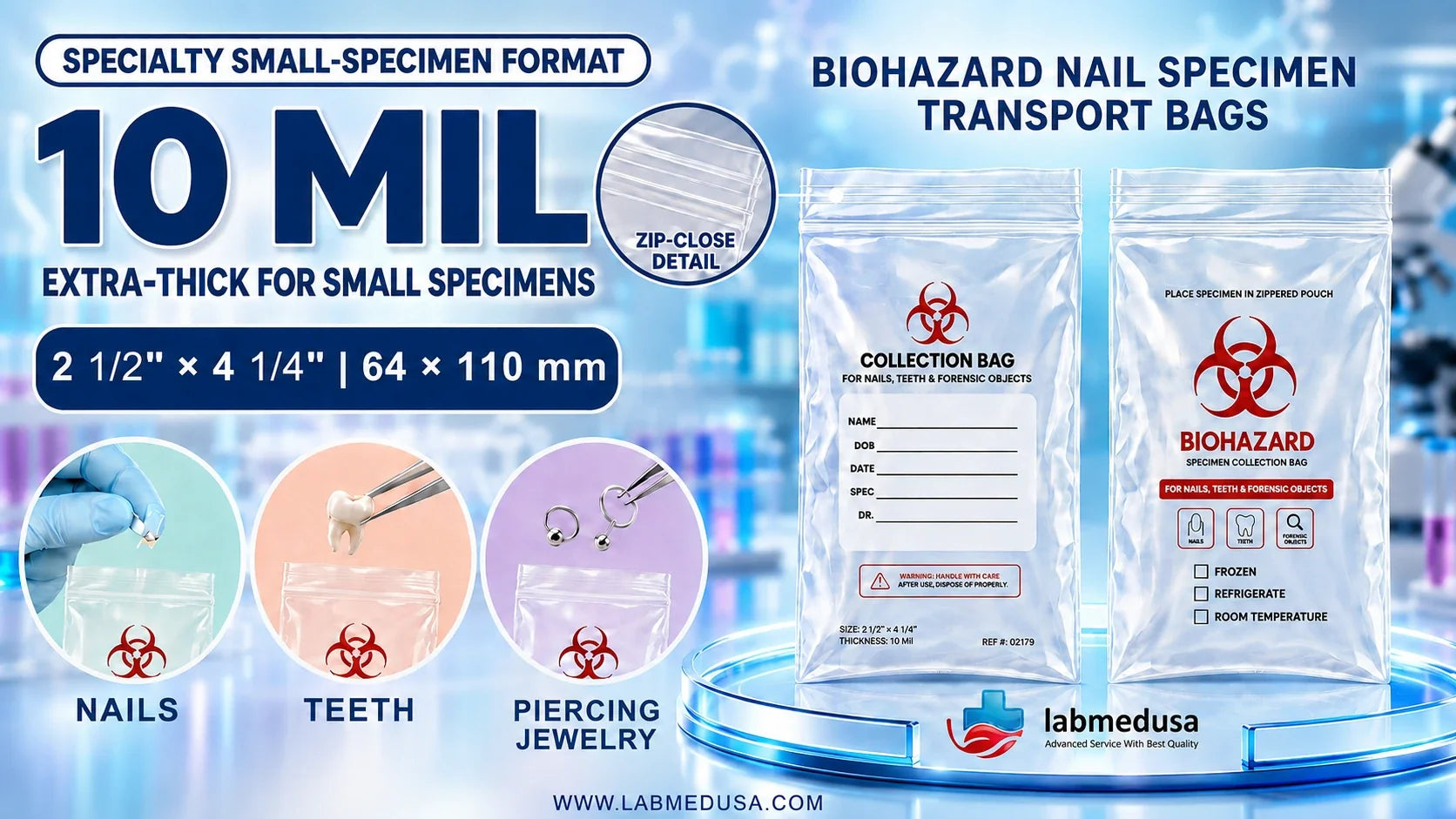
The LabMedUSA 10 Mil Biohazard Nail Specimen Transport Bag provides a compact, transparent format designed specifically for small, non-sharp specimens. Its heavy-duty construction, zip-close opening, write-on identification area, and printed biohazard marking help healthcare and laboratory professionals organize small items throughout collection, storage, and internal transport.
Why Small Specimens Need Purpose-Built Packaging
A compact format for small clinical items
At approximately 64 x 110 mm, or 2 1/2" x 4 1/4" inches, this small specimen transport bag is sized for items that do not require a full-size laboratory transport pouch.
The compact design may be useful for:
-
Nail clippings and nail scrapings
-
Extracted teeth
-
Removed piercing jewelry
-
Small pathology items
-
Small, non-sharp forensic objects
-
Other compact specimens accepted by the receiving facility
Using a right-sized bag keeps the item visible and provides a dedicated place for essential identification information.
Transparent visibility
The clear plastic construction allows staff to confirm that an item is present without repeatedly opening the bag. This can be particularly helpful when handling very small specimens that may otherwise be difficult to locate inside an oversized or opaque package.
Transparency does not replace proper labeling, but it adds an immediate visual confirmation during collection and routing.
Write-on patient identification
Each nail specimen collection bag includes designated fields for information such as:
-
Patient name
-
Date of birth
-
Collection date
-
Specimen type
-
Doctor or clinician
Completing these fields at the point of collection may support a more organized workflow and reduce reliance on loose labels or separate notes. Always follow your facility's patient identification procedures.
What Does 10 Mil Thickness Mean?
Heavy-duty plastic for demanding workflows
One mil equals 0.001 inch. A nominal thickness of 10 mil equals 0.010 inch, or approximately 0.254 mm.
The substantial 10 mil construction gives the bag a more robust feel than many thin general-purpose plastic pouches. This makes thickness one of the product's most distinctive features for buyers searching for a heavy-duty small specimen bag.
The bag should not be described as puncture-proof unless supported by specific testing. It is intended for appropriate small, non-sharp items and is not a substitute for an approved sharps container.
A specialty small-specimen format
The combination of a compact size, 10 mil plastic, transparent body, printed biohazard symbol, patient identification area, and zip closure creates a specialized format for facilities that regularly handle small clinical items.
Rather than presenting the product as simply another plastic bag, it can be viewed as a purpose-built organizational tool for small-specimen workflows.
Common Uses for a Biohazard Nail Specimen Bag
Nail clippings and nail scrapings
Nail samples may be collected for fungal testing, microscopy, pathology, toxicology, or other laboratory examinations. Because test requirements differ, the receiving laboratory determines the correct primary container, preparation method, and storage temperature.
For example, some fungal testing instructions require nail material to be placed in a sterile container. When a sterile primary container is required, this bag should be used only in a role approved by the receiving laboratory, such as identification, organization, or secondary transport.
Extracted teeth
A compact biohazard collection bag can provide an organized place for an extracted tooth when its use is permitted by dental office policy. The bag's clear body makes the tooth visible, while the write-on area helps associate it with the correct patient or procedure.
Extracted teeth may be handled differently depending on whether they are being returned to a patient, retained for evaluation, or managed as regulated waste. Teeth containing dental amalgam may also have separate disposal requirements.
The CDC guidance for extracted teeth should be considered alongside applicable state, local, and facility procedures.
Removed piercing jewelry
Small items of removed body jewelry can be difficult to label and keep organized. A transparent small-specimen bag may provide a convenient way to contain removed rings, studs, barbells, or similar jewelry after a medical procedure, when permitted by facility policy.
This use applies only to removed jewelry or other non-sharp objects. Piercing needles, lancets, scalpels, and contaminated sharp instruments must be placed in an approved sharps container.
Small forensic objects
The compact bag may also be considered for certain small, non-sharp forensic objects when allowed by agency procedures. However, forensic evidence can require tamper-evident packaging, paper packaging, seals, documentation, or specific chain-of-custody controls.
The collection bag should only be used when it is compatible with the investigating agency's evidence-handling protocol.
Key Features of the LabMedUSA Small Specimen Bag
10 mil heavy-duty construction
The bag's nominal 10 mil thickness is its primary differentiating feature. It provides a substantial format for handling small specimens and clinical items without the bulk of a large transport pouch.
Compact 64 x 110 mm size
Measuring approximately 2.52 x 4.33 inches, the bag is designed around small contents rather than standard tubes, cups, or large specimen containers.
Secure zip-close opening
The integrated zip closure provides convenient access and allows the bag to be closed after the item has been placed inside. Users should press across the entire closure to confirm that it is fully engaged.
A zip closure should not automatically be interpreted as certified leakproof packaging. Follow the receiving laboratory's requirements whenever liquid, moist, or regulated specimens are involved.
Transparent plastic
The clear material supports quick visual confirmation of the contents while keeping the printed identification area accessible.
Printed biohazard identification
A prominent biohazard symbol helps distinguish the bag from ordinary storage pouches. Biohazard labeling does not by itself make a complete shipping system or establish regulatory compliance.
Write-on identification panel
The printed information fields provide a consistent place to record patient and specimen details.
Storage condition checkboxes
Checkboxes for frozen, refrigerated, and room-temperature handling allow staff to document the intended storage condition. The checkbox does not determine the correct temperature. Storage must always follow the test directory, facility policy, and receiving laboratory instructions.
Product Specifications
| Feature | Specification |
|---|---|
| Product type | Biohazard nail specimen transport bag |
| Bag size | 64 x 110 mm |
| Approximate size in inches | 2 1/2 x 4 1/4 inches |
| Nominal thickness | 10 mil |
| Metric thickness | Approximately 0.254 mm |
| Closure | Zip-close |
| Appearance | Transparent |
| Identification | Write-on patient and specimen fields |
| Marking | Printed biohazard symbol |
| Storage indicators | Frozen, refrigerated, and room-temperature checkboxes |
| Suggested contents | Nails, extracted teeth, removed piercing jewelry, and approved small non-sharp items |
| Sharps use | Not intended for needles, lancets, blades, or other sharps |
How to Use a Small Specimen Transport Bag
Confirm collection requirements
Before collecting the specimen, consult the receiving laboratory's test directory or your facility's procedure. Determine whether a sterile primary container, preservative, secondary packaging, or particular temperature is required.
Complete the identification fields
Enter all required patient and specimen information legibly. Confirm identifiers according to your organization's patient identification policy.
Place the approved item inside
Insert only specimens or objects accepted for this type of bag. Avoid touching the inside of the bag or contaminating its exterior.
Close the zip seal completely
Press along the entire zip closure and visually inspect it to confirm that it is closed.
Mark the required storage condition
Use the printed checkbox only after verifying whether the specimen should remain at room temperature, be refrigerated, or be frozen.
Add secondary packaging when required
The OSHA Bloodborne Pathogens Standard requires appropriate containment, closure, and labeling for blood and other potentially infectious materials. A second container may be necessary when the exterior could become contaminated or when additional protection is required.
Transportation outside a facility may also be subject to DOT, IATA, carrier, state, or local requirements. This individual collection bag should not be presented as a complete regulated shipping system.
Who Can Benefit From This Specialty Bag?
The LabMedUSA small biohazard specimen bag may be relevant to:
-
Podiatry practices
-
Dermatology offices
-
Dental clinics and oral surgery practices
-
Medical laboratories
-
Pathology departments
-
Outpatient treatment centers
-
Medical and dental education programs
-
Approved forensic collection workflows
-
Body piercing studios working under applicable health procedures
The specialty format is particularly useful for organizations that need a professional alternative to oversized specimen bags or unmarked general-purpose pouches.
Choosing the Right Small Specimen Bag
Before ordering, consider the following questions:
-
Is the specimen dry, liquid, moist, sharp, or potentially infectious?
-
Does the receiving laboratory require a sterile primary container?
-
Is a secondary specimen transport bag required?
-
Does the 64 x 110 mm size provide sufficient room?
-
Are patient identification fields needed?
-
Does the workflow require a printed biohazard symbol?
-
Will the specimen be stored at room temperature, refrigerated, or frozen?
-
Are additional transport or chain-of-custody controls required?
A carefully selected bag can support a more efficient workflow, but it must always be used within the requirements established by the laboratory and healthcare facility.
Frequently Asked Questions
What is a nail specimen transport bag?
A nail specimen transport bag is a compact, labeled pouch used to organize nail clippings, nail scrapings, or an approved primary specimen container during handling and transport. Its exact role depends on the receiving laboratory's collection requirements.
How large is a 64 x 110 mm specimen bag?
A bag measuring 64 x 110 mm is approximately 2.52 x 4.33 inches. This compact size is suitable for many small items that do not require a full-size laboratory transport bag.
What does 10 mil mean on a plastic bag?
Ten mil refers to a nominal plastic thickness of 0.010 inch, which is approximately 0.254 mm. Mil is a measurement of thickness and should not be confused with millimeters.
Can the bag hold an extracted tooth?
It may be used to contain an extracted tooth when allowed by the dental practice's procedures. Requirements may vary depending on whether the tooth is returned to the patient, sent for evaluation, used for education, or discarded.
Can it hold removed piercing jewelry?
The bag may be suitable for removed rings, studs, barbells, and similar non-sharp jewelry when permitted by facility policy. It is not intended for piercing needles or other sharps.
Is this a sterile specimen bag?
Do not describe the bag as sterile unless the product packaging and supplier documentation specifically confirm sterilization. If a laboratory test requires a sterile primary container, follow the receiving laboratory's instructions.
Is the bag a sharps container?
No. Needles, lancets, scalpels, blades, and other contaminated sharps require an approved closable, puncture-resistant sharps container.
Can the bag be used to ship specimens?
The bag may be one component of a specimen handling system, but it should not be presented as a complete compliant shipping package. Shipping requirements depend on specimen classification, destination, carrier, and applicable regulations.
A Specialized Solution for Small Specimen Handling
Small specimens deserve a packaging format designed around their scale. The LabMedUSA 10 Mil Biohazard Nail Specimen Transport Bag combines a compact profile with transparent visibility, heavy-duty 10 mil plastic, a zip-close opening, patient identification fields, and clear biohazard marking.
It is a practical specialty option for healthcare, dental, laboratory, and other approved professional workflows involving nails, teeth, removed piercing jewelry, and small non-sharp items.
Explore the 10 Mil Biohazard Nail Specimen Transport Bag from LabMedUSA or contact the LabMedUSA team for current specifications, packaging quantities, and ordering assistance.



Leave a comment