



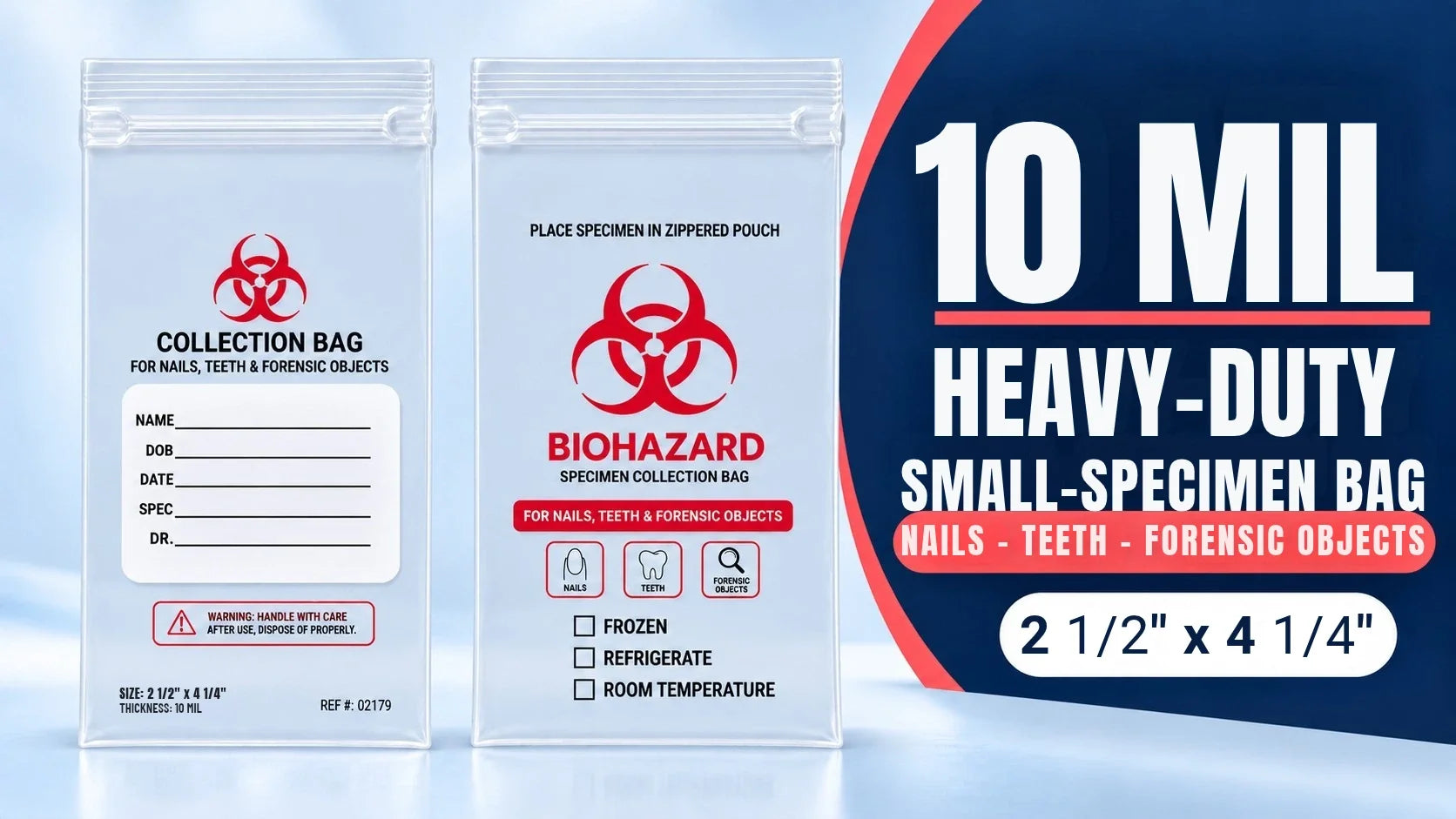
10 Mil Thickness Biohazard Nail Specimen Bags for Small Specimens and Forensic Objects
Small specimens can create significant handling challenges. Dry nail clippings, extracted teeth, and small forensic objects can be difficult to see, identify, and organize when placed inside an oversized transport pouch. Using a compact specimen collection bag helps keep these small contents visible while providing a dedicated area for identification and handling information.
The LabMedUSA 10 Mil Biohazard Nail Specimen Transport Bag is a specialty small-specimen bag designed for approved dry, non-sharp contents. Its transparent construction, heavy-duty 10 mil material, zip-close opening, printed biohazard marking, and write-on identification fields support organized collection and internal handling in laboratories, podiatry offices, dermatology practices, dental facilities, and approved forensic workflows.
Measuring 64 x 110 mm, approximately 2 1/2 x 4 1/4 inches, this compact biohazard bag is purpose-sized for items that do not require a full-size specimen transport bag.
Watch the 10 Mil Nail Specimen Bag Video
See the bag’s compact dimensions, transparent material, identification panel, zip closure, and small-specimen applications in the LabMedUSA product video.
Watch the 10 Mil Small Specimen Transport Bag Video on YouTube
The video provides a closer look at why a heavy-duty, right-sized bag can be more practical for handling small specimens and approved forensic objects than an oversized general-purpose pouch.
What Is a Biohazard Nail Specimen Bag?
A biohazard nail specimen bag is a compact, labeled plastic pouch used for the organized collection or handling of dry nail material when the receiving laboratory accepts this type of container. It may also be useful for extracted teeth and selected small, non-sharp forensic objects when permitted by the responsible facility or agency.
Unlike an unmarked plastic bag, a purpose-built nail specimen collection bag provides visible biohazard identification and printed fields for recording patient, specimen, collection, and clinician information. These features help create a more consistent small-specimen workflow.
The bag does not determine which test will be performed, preserve a specimen by itself, or replace the receiving laboratory’s collection instructions. The correct primary container, storage temperature, secondary packaging, and transport method must always be confirmed before collection.
Why Small Specimens Need Purpose-Built Packaging
Small contents are easier to see
Nail fragments, extracted teeth, and compact forensic objects can become difficult to locate inside a standard laboratory transport pouch. A smaller clear bag keeps the contents within a concentrated visible area, allowing staff to confirm that an item is present without unnecessarily reopening the package.
Transparent visibility does not replace proper labeling, but it can provide a quick visual check during collection, accessioning, storage, or internal routing.
A compact bag reduces unnecessary empty space
Large specimen bags are valuable for tubes, cups, multiple containers, and paperwork. However, they may be excessive for one tiny dry item. A 64 x 110 mm small specimen bag offers a more proportional format for compact contents and takes up less space in collection kits, supply drawers, and organized storage systems.
Dedicated fields support clear identification
Small loose items should never rely on memory or position for identification. Printed write-on fields provide a consistent place to record the information required by the facility.
Depending on the workflow, the bag may provide space for:
-
Patient name
-
Date of birth
-
Collection date
-
Specimen type or anatomical site
-
Doctor or ordering clinician
-
Required storage condition
All required identifiers should be completed legibly and matched with the associated requisition or record according to the organization’s policy.
What Does 10 Mil Thickness Mean?
Understanding the mil measurement
A mil is a unit used to describe material thickness. One mil equals 0.001 inch. A nominal thickness of 10 mil equals 0.010 inch, approximately 0.254 mm.
Mil should not be confused with millimeters. In this product specification, 10 mil refers to the thickness of the plastic film, while 64 x 110 mm describes the dimensions of the bag.
Why 10 mil matters for a small specimen bag
The substantial 10 mil construction gives the bag a firmer, heavier-duty feel than many thin general-purpose pouches. This is a valuable feature for buyers looking for a durable small specimen bag that remains compact and easy to organize.
The material thickness should be described accurately as 10 mil heavy-duty construction.
Not a substitute for a sharps container
This bag is intended for suitable dry, non-sharp contents. Needles, lancets, blades, scalpels, and other contaminated sharps require an approved rigid sharps container. Small size does not make a sharp object appropriate for a flexible specimen bag.
Common Uses for a 10 Mil Small Specimen Bag
Dry nail clippings and subungual debris
Nail material may be collected for fungal testing, microscopy, histopathology, toxicology, molecular testing, or another laboratory examination. The applicable test determines how the material should be collected and packaged.
When accepted by the receiving laboratory, a nail specimen bag can provide a compact place for dry nail clippings and subungual debris. The clear body allows the specimen to remain visible, while the printed identification area helps associate it with the correct patient and collection site.
Not every laboratory accepts nail samples in the same type of container. Some require a sterile container, a paper envelope, a special collection kit, or another test-specific system. Confirm the laboratory’s current specimen requirements before collection.
Extracted teeth
A compact biohazard specimen bag may be used to contain an extracted tooth when permitted by the dental facility’s procedure. Its transparent construction allows the tooth to remain visible, and the write-on area supports identification before storage, evaluation, disposal, or return to the patient.
Requirements can vary according to what will happen to the tooth after extraction. Teeth retained for pathology, education, research, or waste handling may follow different procedures. Teeth containing dental amalgam may also require specific disposal practices.
Small forensic objects
Small forensic objects can be difficult to label and organize because they may be visually subtle, lightweight, or easily misplaced. When approved by the responsible agency, a transparent small-item bag may help contain selected dry, non-sharp forensic objects while keeping them visible for identification.
Potential applications may include certain small recovered objects, trace-related items, or other non-sharp materials that are compatible with plastic packaging. The correct packaging depends on the object, its condition, the examination requested, and the agency’s evidence-handling procedure.
A standard zip-close specimen bag is not automatically tamper-evident and may not meet chain-of-custody requirements by itself. Forensic evidence may require serialized evidence bags, tamper-evident seals, paper packaging, breathable containers, moisture control, documented transfers, or other specialized measures. Always follow the investigating organization’s protocol.
Other approved dry, non-sharp items
The compact bag may also be considered for other small clinical, pathology, research, or forensic items when the receiving organization specifically permits its use. The material should be compatible with clear polyethylene and should not require a sterile, liquid-tight, tamper-evident, or breathable primary container.
Key Features of the LabMedUSA Nail Specimen Transport Bag
10 mil heavy-duty plastic construction
The bag’s nominal 10 mil thickness is its primary distinguishing feature. It gives the compact pouch a substantial format for routine handling of suitable small specimens and forensic objects.
Compact 64 x 110 mm dimensions
At approximately 2 1/2 x 4 1/4 inches, the bag is designed around small contents rather than specimen cups, collection tubes, instruments, or full-size requisition forms.
Transparent material for quick visibility
The clear bag allows personnel to visually confirm that a small item is present without obscuring the printed identification panel.
Press-to-close zip closure
The integrated zipper provides convenient access and closure for approved contents. After inserting the item, users should press across the full width of the closure and visually confirm that it is completely engaged.
A zip closure should not automatically be described as certified leakproof or suitable for liquids unless supporting product testing confirms those claims.
Printed biohazard marking
A prominent biohazard symbol makes the bag easier to distinguish from an ordinary storage pouch. The marking supports visual identification, but it does not determine the regulatory classification of the contents or make the bag a complete compliant shipping system.
Write-on identification fields
The printed panel provides a consistent location for patient, specimen, collection, and clinician information. Clear labeling is especially valuable for small contents that may otherwise look similar.
Storage-condition checkboxes
Printed checkboxes allow users to indicate frozen, refrigerated, or room-temperature handling. The checkbox documents the selected condition but does not determine which temperature is correct. Storage requirements must come from the test directory, facility procedure, or responsible agency.
Product Specifications
| Feature | Specification |
|---|---|
| Product type | Biohazard nail specimen transport bag |
| Bag dimensions | 64 x 110 mm |
| Approximate dimensions | 2 1/2 x 4 1/4 inches |
| Nominal thickness | 10 mil |
| Approximate metric thickness | 0.254 mm |
| Closure | Press-to-close zipper |
| Appearance | Transparent |
| Identification | Write-on patient and specimen fields |
| Marking | Printed biohazard symbol |
| Storage indicators | Frozen, refrigerated, and room-temperature checkboxes |
| Potential contents | Approved dry nails, extracted teeth, small forensic objects, and other suitable non-sharp items |
| Sharps use | Not intended for needles, lancets, blades, or other sharps |
How to Use a Small Specimen Transport Bag
1. Confirm the receiving requirements
Before collection, review the applicable laboratory test directory, dental procedure, pathology protocol, or forensic evidence-handling policy. Confirm the required container, preparation method, storage condition, and transport system.
2. Prepare the identification information
Record all required patient, case, specimen, source, collection, or clinician details. Make sure the information matches the accompanying record or requisition.
3. Place only an approved item inside
Insert the appropriate dry, non-sharp specimen or object without contaminating the outside of the bag. Do not place needles, blades, liquids, preservatives, or formalin inside unless the manufacturer and receiving organization explicitly approve that use.
4. Close the zipper completely
Press along the entire closure and inspect it from edge to edge. Avoid overfilling the bag or placing material across the zipper track.
5. Mark the required storage condition
Select the appropriate checkbox only after confirming whether the item should remain at room temperature, be refrigerated, or be frozen.
6. Add the required secondary packaging
The compact bag may be only one part of the handling system. Use approved secondary containment, absorbent material, tamper-evident sealing, rigid outer packaging, or other components when required.
7. Follow the documented transfer process
Deliver the item according to the receiving laboratory’s, facility’s, courier’s, or investigating agency’s procedure. Forensic objects may require documented custody transfers that a standard specimen label does not provide.
Nail Specimen Collection and Pre-Analytical Quality
Why the collection step matters
Laboratory testing begins before the specimen reaches an analyzer or microscope. The amount collected, collection site, cleanliness of the sample, container choice, labeling, temperature, and transport time can all affect whether the specimen is suitable for examination.
For nail testing, the receiving laboratory may provide instructions about cleaning the nail, selecting the affected area, collecting subungual debris, avoiding unsuitable substances, and supplying enough material. The nail specimen bag helps with containment and identification only when it matches the laboratory’s protocol.
Dry specimens require dry handling
If a procedure calls for dry nail material, avoid adding saline, water, formalin, or another liquid unless the test instructions specifically require it. Moisture can change handling needs and may make a different primary container necessary.
The specimen site should be specific
When required, identify the anatomical source clearly. A description such as “right great toenail” provides more useful information than the word “nail” alone. Follow the receiving laboratory’s requested terminology.
Forensic Object Packaging Considerations
Packaging should match the object
There is no universal bag for every forensic object. The correct choice depends on whether the item is wet or dry, sharp or non-sharp, chemically reactive, fragile, biological, trace-sized, or potentially contaminated.
Plastic packaging may be inappropriate for damp biological evidence, objects requiring ventilation, materials vulnerable to condensation, or evidence governed by a paper-packaging procedure. A compact clear bag should only be used when the responsible agency confirms that plastic packaging is suitable.
Chain of custody requires more than a label
Write-on fields support identification, but formal chain of custody may require a unique case number, collector signature, date and time, tamper-evident seal, transfer log, receiving signature, and documented storage location.
The bag should be described as an organizational or containment option for approved small forensic objects, not as a complete chain-of-custody system.
Tamper evidence must be verified
A reusable or press-to-close zipper does not visibly show whether the package has been reopened. If tamper evidence is required, use the approved evidence seal or packaging system specified by the agency.
Choosing the Right Small Specimen Bag
Confirm the type of content
Determine whether the content is dry, moist, liquid, sharp, infectious, fragile, chemically reactive, or evidentiary. This is the first step in selecting suitable packaging.
Check the required container
The receiving laboratory or agency may require a sterile vial, paper envelope, rigid container, evidence bag, culture medium, preservative, or another specialized package. Do not substitute a different container based only on convenience.
Verify the dimensions
The 64 x 110 mm nail specimen bag is intended for small items. Confirm that the contents fit without forcing, folding, damaging, or overfilling the pouch.
Evaluate labeling needs
Consider whether the workflow requires patient identifiers, collection site, case number, collector initials, storage condition, or other information. Additional labels or documentation may be needed.
Identify secondary packaging requirements
A primary or inner bag may need to be placed inside a larger biohazard transport bag, approved evidence package, or rigid shipping container. External transportation can introduce requirements beyond those used for internal movement.
Common Mistakes to Avoid
Using the bag for needles or other sharps
Heavy-duty film is not a substitute for an approved sharps container.
Adding liquid to a dry specimen bag
The bag should not be assumed suitable for liquid specimens, formalin, saline, or transport media.
Treating a zipper as tamper evidence
A standard zip closure is not the same as a serialized tamper-evident seal.
Using it as a complete shipping package
The small bag may be one component within an approved transport system, but it should not be promoted as a complete DOT, IATA, USPS, or carrier-compliant shipping package by itself.
Leaving identification fields incomplete
Clear material cannot compensate for missing patient, specimen, case, or collection information.
Who May Benefit From This Specialty Bag?
The 10 mil biohazard nail specimen bag may be relevant to:
-
Podiatry practices
-
Dermatology offices
-
Clinical mycology laboratories
-
Pathology and dermatopathology laboratories
-
Dental and oral surgery practices
-
Hospital laboratory outreach programs
-
Medical and dental education programs
-
Approved forensic collection units
-
Evidence-processing teams
-
Healthcare and laboratory procurement departments
-
Organizations assembling small-specimen collection kits
Laboratories that distribute collection supplies to multiple referring practices may particularly benefit from a standardized small-specimen format with printed identification fields.
Benefits for Laboratory and Healthcare Procurement Teams
A specialized alternative to oversized bags
Procurement teams can match the packaging format more closely to the contents instead of relying on one large bag for every application.
Consistent identification layout
Printed fields can support a repeatable collection workflow across departments, clinics, or outreach locations.
Compact storage footprint
The small format requires less storage space than full-size transport pouches and can fit conveniently within purpose-built collection kits.
Multiple approved applications
When compatible with facility procedures, one specialty bag may support dry nail collection, extracted-tooth handling, and selected small forensic object workflows.
Frequently Asked Questions
What is a 10 mil nail specimen bag?
A 10 mil nail specimen bag is a compact, heavy-duty plastic pouch designed to contain or organize approved dry nail material and other suitable small, non-sharp items. Its exact use depends on the receiving organization’s protocol.
How large is a 64 x 110 mm specimen bag?
A bag measuring 64 x 110 mm is approximately 2 1/2 x 4 1/4 inches. This compact size is intended for small specimens and objects rather than tubes, specimen cups, instruments, or full-size paperwork.
What does 10 mil mean on a specimen bag?
Ten mil describes a nominal material thickness of 0.010 inch, approximately 0.254 mm. It is a thickness measurement, not a metric dimension.
Can the bag be used for fungal nail testing?
It may be used for dry nail clippings or subungual debris when accepted by the laboratory performing the test. Some laboratories require another container, so collection instructions must be checked first.
Can it contain an extracted tooth?
The bag may be used when permitted by the dental facility’s procedure. Handling requirements vary depending on whether the tooth will be returned, examined, retained, used for education, or discarded.
Can this bag hold forensic objects?
It may be suitable for selected dry, non-sharp forensic objects when approved by the responsible agency. It is not automatically tamper-evident and does not replace evidence seals, chain-of-custody documentation, or object-specific packaging requirements.
Is this nail specimen bag sterile?
Do not consider or advertise the bag as sterile unless current product documentation specifically confirms sterilization. If a test requires a sterile primary container, use the container specified by the laboratory.
Is the bag puncture-proof?
No puncture-proof claim should be made based only on the 10 mil thickness. Sharp objects belong in an approved rigid sharps container.
Is the zip-close bag leakproof?
A zip closure should not be described as certified leakproof unless supported by applicable product testing. This bag is positioned for approved dry, non-sharp contents.
Can it be used to ship specimens?
The bag may serve as one component of an approved handling system, but it is not a complete regulated shipping package by itself. Shipping requirements depend on the contents, classification, carrier, and destination.
Where can I buy small biohazard nail specimen bags?
The 10 Mil Biohazard Nail Specimen Transport Bag is available through LabMedUSA for laboratories, healthcare facilities, dental practices, and other professional buyers seeking specialty small-specimen collection supplies.
A Specialty Solution for Small Specimens and Forensic Objects
Small contents deserve packaging designed around their scale. The LabMedUSA 10 Mil Biohazard Nail Specimen Transport Bag combines heavy-duty 10 mil construction with transparent visibility, a compact 64 x 110 mm profile, a press-to-close zipper, printed patient and specimen fields, storage-condition checkboxes, and prominent biohazard identification.
For facilities handling approved dry nail specimens, extracted teeth, selected forensic objects, and other small non-sharp items, this specialty format offers a professional alternative to oversized or unmarked pouches.
Explore the 10 Mil Biohazard Nail Specimen Transport Bag
Visit LabMedUSA for laboratory supplies, medical supplies, specimen collection products, biohazard bags, transport containers, and clinical consumables.
For dry, non-sharp contents only. Confirm container acceptance, storage conditions, evidence requirements, and transport procedures with the receiving laboratory, facility, or agency before use.



Leave a comment