



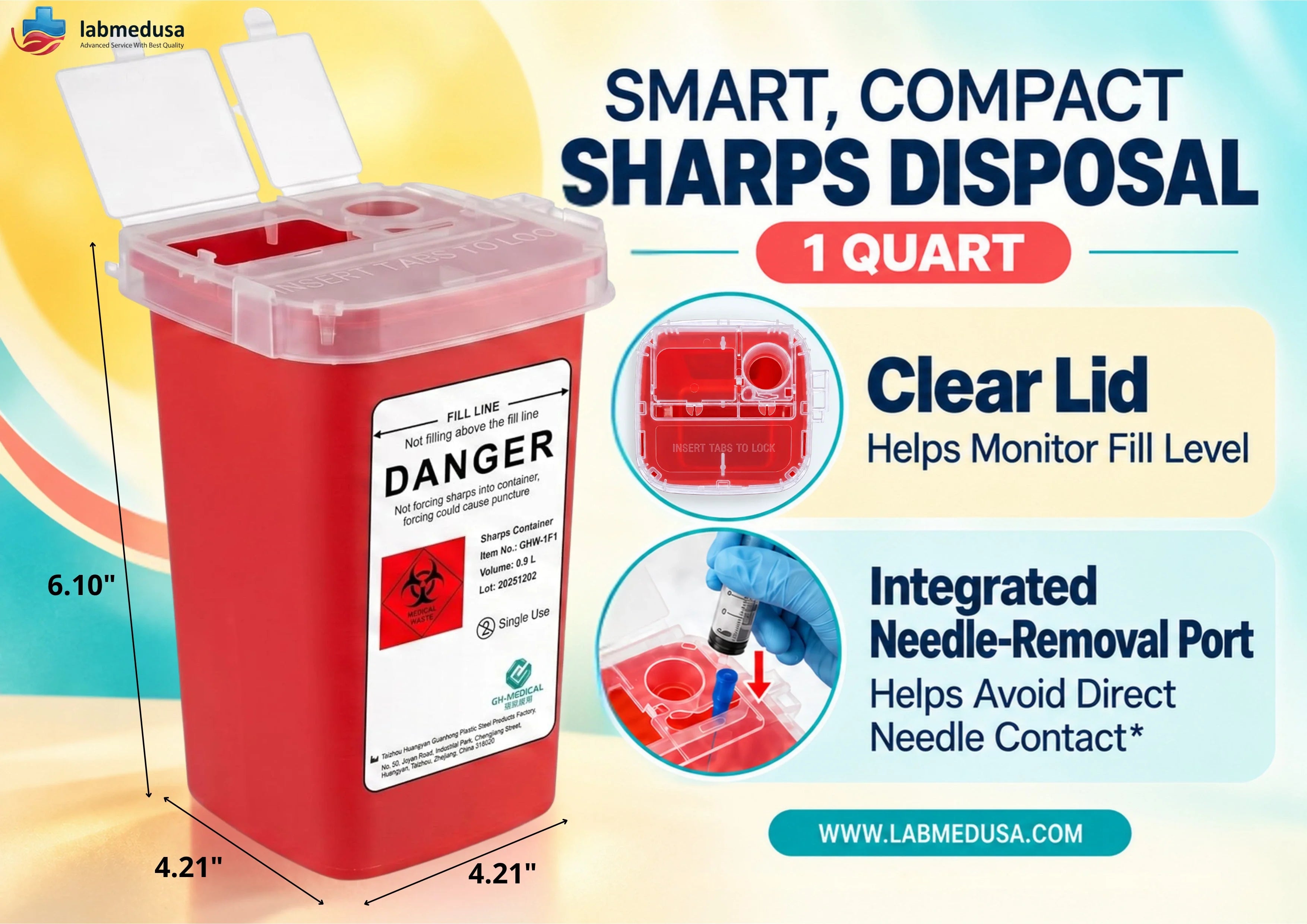
1 Quart Sharps Container: Compact Needle Disposal for Home, Phlebotomy and Travel
Safe disposal is an important part of handling needles, syringes, lancets, and other medical sharps. Whether sharps are used in a clinic, during mobile phlebotomy, for home diabetes care, or while traveling, used needles should never be left loose where they could accidentally injure another person.
A 1 quart sharps container provides a compact solution for collecting used needles and other compatible sharps while taking up much less space than a large medical waste container.
Designed for locations where portability and easy access matter, a small biohazard sharps container can be especially useful for phlebotomists, home health professionals, insulin users, caregivers, and other people who regularly handle medical sharps.
What Is a 1 Quart Sharps Container?
A 1 quart sharps disposal container is a small rigid container designed to hold used needles and other approved sharp medical waste until the container is ready for proper disposal.
Sharps can include needles, syringes, lancets, insulin pen needles, auto-injectors, and other devices with sharp points or edges capable of cutting or puncturing skin.
The FDA recommends placing used needles and other sharps into a sharps disposal container immediately after use. Appropriate sharps containers are designed with rigid construction, leak-resistant sides and bottom, and a secure lid to help keep discarded sharps contained.
For users who do not generate a large volume of sharps waste, the compact 1 quart size can provide an effective balance between capacity and portability.
Why Choose a Compact 1 Quart Sharps Container?
Large sharps containers make sense in high-volume medical environments, but bigger is not always more convenient.
A smaller 1 quart needle disposal container can fit more easily on a medical cart, workstation, phlebotomy tray, home medication area, or inside a mobile healthcare setup.
This compact format is particularly useful when sharps need to be discarded close to the point of use. Reducing the distance between using a needle and disposing of it can help prevent loose sharps from being temporarily placed on counters, trays, tables, or other surfaces.
Portable sharps containers are also useful when people are away from home. A small travel-size sharps disposal container can provide a designated place for used sharps when immediate disposal options are not available.
Clear Lid Helps Users Monitor the Fill Level
One useful feature found on many compact 1 quart sharps containers is a clear or translucent lid.
Instead of repeatedly opening or handling the container to estimate remaining capacity, the transparent portion allows users to visually monitor the contents and determine when the sharps container is approaching its recommended fill level.
This matters because sharps containers should not be overfilled.
Overfilling can make it more difficult to safely insert additional items and may increase the chance of accidental contact with previously discarded needles or other sharps.
Users should follow the container's indicated fill line and prepare for proper disposal before the container becomes overfilled.
For busy healthcare professionals, a visible fill level also makes it easier to recognize when a replacement container should be prepared.
Built-In Needle Removal Port: What Does It Do?
Another feature available on some small sharps disposal containers is a built-in needle removal or needle unwinding port.
For compatible needle and syringe systems, the needle can be positioned inside the designated port while the syringe is rotated or manipulated according to the manufacturer's directions. The port holds the needle while it separates from the syringe, allowing the needle to drop directly into the sharps container.
This type of design can help reduce direct hand contact with the needle during compatible removal procedures.
This is why the feature may also be described as a touch-free needle removal port, needle unwinding port, or hands-off needle removal feature.
However, the removal feature should only be used with compatible devices and exactly as directed by the sharps container manufacturer. Needles should never be manually removed simply to save space inside a container.
A Practical Sharps Container for Mobile Phlebotomists
Mobile phlebotomists work differently from staff operating at a fixed blood-draw station.
Instead of having a large sharps disposal bin permanently positioned beside them, mobile professionals may need to carry essential supplies between patient locations.
A compact phlebotomy sharps container can fit more naturally into this workflow.
The smaller footprint makes it easier to position near the blood-draw area and transport as part of a properly organized mobile setup.
For mobile healthcare professionals, convenient access to an appropriate sharps disposal container means a used needle can be discarded immediately rather than transported loose or left temporarily on another surface.
A 1 quart sharps container may therefore be a practical choice for mobile phlebotomy, home healthcare visits, temporary testing locations, and other lower-volume environments.
Sharps Disposal for Diabetes and Insulin Use at Home
Sharps disposal is not limited to hospitals and laboratories.
People managing diabetes may regularly use insulin syringes, insulin pen needles, lancets, and finger-stick devices at home.
These items still qualify as sharps after use.
A small sharps container for insulin needles provides a designated place to discard used sharps immediately while remaining compact enough for many home medication areas.
Lancets, needles, syringes, and insulin-related injection devices should not be placed loose in household trash or recycling containers because they may create an accidental needlestick or puncture risk for family members, sanitation workers, housekeepers, and others who come into contact with the waste.
A compact container can therefore be especially practical for people who generate sharps regularly but do not need the capacity of a large clinical waste container.
Useful for Travel and On-the-Go Sharps Disposal
People who use injectable medications do not stop needing safe disposal when they leave home.
A portable sharps container for travel can provide a controlled place to store used needles until an approved disposal option is available.
Travelers who use injectable medications should also check applicable transportation and local sharps disposal requirements before traveling.
A compact 1 quart container offers more capacity than many tiny pocket-style needle containers while still remaining substantially smaller than high-volume clinical sharps bins.
This makes the format useful for longer trips, mobile medical work, temporary clinics, home health visits, and other situations where portability is important.
What Can Be Placed in a Sharps Container?
Depending on the opening size and the manufacturer's instructions, a sharps container may be suitable for items such as hypodermic needles, syringes with attached needles, lancets, insulin pen needles, finger-stick devices, small injection devices, and other approved medical sharps.
Not every sharps container is designed for every type of medical waste.
Always check the manufacturer's instructions before disposing of unusually large devices, glass items, medication vials, contaminated materials, or other healthcare waste.
Sharps containers are specifically intended to manage items capable of puncturing or cutting skin. They should not automatically be treated as general-purpose medical waste bins.
Do Not Overfill a Sharps Disposal Container
One of the simplest sharps safety practices is also one of the most important: stop adding sharps before the container becomes overfilled.
Trying to force another syringe or needle into an already crowded sharps bin can bring the user's hand closer to contaminated sharps near the opening.
A visible fill line, together with a clear lid, can make it easier to monitor available capacity.
When the appropriate fill level is reached, follow the manufacturer's instructions for activating the final closure.
Once permanently closed, a disposable sharps container should not be reopened or reused.
How Should a Full Sharps Container Be Disposed Of?
Sharps disposal requirements can vary by state and local jurisdiction.
Depending on where you live, available options may include supervised collection locations, pharmacies, hospitals, healthcare facilities, household hazardous waste collection sites, approved mail-back programs, or special waste pickup services.
Users should check with their local health department, waste service, healthcare provider, pharmacist, or other appropriate local authority to determine which sharps disposal programs are available in their area.
Never assume that a sealed sharps container can automatically be placed into ordinary household trash. Requirements differ by location.
Features to Consider When Choosing a Small Sharps Container
When comparing a 1 quart sharps container for needles and syringes, consider more than capacity alone.
Look for rigid, puncture-resistant construction, leak-resistant sides and bottom, a secure lid, clear biohazard labeling, a visible fill indicator, stable positioning during use, and an opening appropriate for the sharps you intend to discard.
Features such as a clear lid, temporary closure, final locking mechanism, and a built-in needle removal port can add convenience for specific workflows.
The right container should ultimately match where it will be used, the types of sharps being discarded, how quickly it will fill, and the applicable disposal requirements.
Why Point-of-Use Sharps Disposal Matters
A sharps container works best when it is available where the sharp is actually used.
Immediate disposal reduces the amount of handling that occurs after a needle has completed its job.
Used sharps should not be left on countertops, stored loose in bags, placed into pockets, or carried around while searching for somewhere to discard them.
Immediate placement into an appropriate needle disposal container can help reduce the risk of accidental needlesticks, cuts, and puncture injuries.
For this reason, compact containers can complement larger sharps disposal systems by making safe disposal more accessible in locations where a full-size container would be inconvenient.
1 Quart Sharps Container for Professional and Everyday Use
The value of a 1 quart biohazard sharps container comes from its combination of compact size, practical capacity, and point-of-use accessibility.
For a mobile phlebotomist, it can provide a portable sharps disposal option that fits more naturally into a mobile workflow.
For a person managing diabetes at home, it can provide a dedicated location for used insulin needles and lancets.
For travel, it offers a small sharps disposal solution that can be carried when appropriate.
And in clinics, laboratories, medical offices, and other professional environments, compact sharps containers can be positioned in areas where lower-volume sharps disposal is needed.
Features such as a clear lid for fill-level visibility and a built-in needle removal port for compatible systems can make a well-designed small sharps container easier to integrate into everyday use.
Frequently Asked Questions About 1 Quart Sharps Containers
Is a 1 quart sharps container good for insulin needles?
A 1 quart container can be a convenient size for many people who use insulin syringes, pen needles, or lancets at home. Always confirm that the specific container is designed for the sharps you intend to discard.
Can mobile phlebotomists use a 1 quart sharps container?
Compact sharps containers are commonly useful in portable healthcare and phlebotomy applications because their smaller footprint is easier to accommodate in mobile setups.
What is the purpose of a clear sharps container lid?
A clear or translucent lid provides better visibility of the contents and makes it easier to monitor the fill level without unnecessary handling.
What does a needle removal port do?
On compatible systems, a built-in needle removal or unwinding port can secure the needle while it is separated from the syringe according to the manufacturer's instructions, allowing the needle to fall into the container with reduced direct hand contact.
Can I throw a full sharps container into household trash?
Do not assume that you can. Sharps disposal requirements vary by location. Check state and local regulations or contact your local health department or waste authority for approved disposal methods.
Should sharps containers be completely filled?
No. Sharps containers should not be overfilled. Follow the fill line and the manufacturer's directions for closing and replacing the container.
Safer Sharps Disposal Starts With the Right Container
From needle disposal at home to mobile phlebotomy, diabetes care, clinics, laboratories, healthcare offices, and travel, having an appropriate sharps container nearby helps make immediate disposal easier.
A compact 1 quart sharps container with a clear lid and needle removal port provides a practical option when users need sharps containment without the footprint of a large medical waste container.
Explore sharps containers, specimen collection supplies, phlebotomy supplies, laboratory consumables, and medical supplies from LabMedUSA for professional healthcare, laboratory, and specimen collection applications.


Leave a comment