



1000µL Filter Pipette Tips: Understanding Aerosol Barriers, Pipetting Accuracy, and Contamination Control
Accurate liquid handling depends on more than the micropipette itself.
The disposable pipette tip is the part of the system that directly contacts the liquid, holds the sample during aspiration, and releases it during dispensing. Its fit, material, internal surface, capacity, and design can all influence everyday pipetting performance.
For laboratories routinely transferring volumes up to 1000µL, or 1mL, filtered pipette tips can also provide an additional barrier between the sample and the pipettor.
This guide explains how 1000µL filter pipette tips work, why the internal filter matters, how pipetting technique affects accuracy, and what laboratories should consider when selecting tips for routine liquid handling.
What Is a 1000µL Pipette Tip?
A 1000µL pipette tip is designed for liquid-handling applications requiring volumes up to approximately 1 milliliter.
This size is commonly paired with compatible adjustable-volume micropipettes for larger micro-volume transfers.
Common applications can include:
- Sample aliquoting
- Buffer transfer
- Reagent preparation
- Serial dilution
- Laboratory research
- Sample preparation
- Quality-control workflows
- Educational laboratory work
- Routine biological and chemical liquid handling
A 1000µL tip alone does not determine pipetting accuracy.
Reliable liquid handling depends on the complete system, including the micropipette, pipette tip, selected volume, liquid characteristics, operator technique, temperature, and condition of the instrument.
How Does a Micropipette Work?
Many common laboratory micropipettes operate using an air-displacement mechanism.
Inside the pipette is a piston. When the plunger is pressed or released, the piston moves and changes the volume of air inside the system.
The pipette tip contains the liquid while a small air space remains between the liquid and the internal pipette mechanism.
During aspiration:
1. The plunger is pressed to the appropriate stop.
2. The tip is placed into the liquid.
3. The plunger is slowly released.
4. Movement of the piston creates a pressure difference.
5. Liquid enters the pipette tip.
During dispensing, the process is reversed and the liquid is pushed from the tip into the receiving vessel.
Because an air pathway exists between the sample and the pipette, contamination control becomes an important consideration during certain laboratory procedures.
What Is the Filter Inside a Pipette Tip?
Filter pipette tips contain a small porous barrier positioned near the upper portion of the tip.
This is often referred to as an:
- Aerosol barrier
- Pipette tip filter
- Filter plug
- Protective filter
Its purpose is not to filter the sample before dispensing.
Instead, it provides a physical barrier between the liquid-handling area of the tip and the pipette itself.
Our 1000µL filter pipette tips include an internal aerosol barrier designed to help reduce the movement of droplets and aerosols toward the pipettor during routine liquid handling.
Why Are Aerosols Important in Pipetting?
Aerosols are extremely small liquid droplets or particles that may become suspended in air.
They can be created during routine laboratory activities, including pipetting.
For example, rapid aspiration, forceful dispensing, or accidental over-aspiration can contribute to droplets or aerosols moving higher inside the pipette tip.
Without a barrier, contaminants can potentially reach the lower section of the pipette.
This creates another possible contamination pathway.
Imagine this sequence:
Sample A → Pipette tip → Pipettor contamination → New tip → Sample B
Even though the disposable tip was changed, contamination already present inside the pipettor could potentially become a source of carryover.
A filter tip provides an additional physical barrier in this pathway.
When Are Filter Pipette Tips Especially Useful?
Filtered tips may be useful when contamination prevention is particularly important.
Examples can include:
- PCR preparation
- DNA workflows
- RNA workflows
- Molecular biology
- Microbiology
- Cell-related research
- Clinical laboratory procedures
- Diagnostic sample handling
- Sensitive reagent preparation
- Low-concentration analytes
- Valuable or limited-volume samples
Laboratories should always follow their own SOPs and testing requirements when determining whether filtered tips are appropriate for a particular procedure.
Filter Tips Do Not Replace Good Pipetting Technique
A filter provides additional protection, but it does not make a pipetting workflow contamination-proof.
Good laboratory technique is still essential.
Important practices include:
- Using a fresh tip when required by the procedure
- Keeping the pipette upright during aspiration
- Avoiding excessively rapid plunger movement
- Preventing liquid from entering the pipette body
- Keeping the micropipette clean
- Following recommended calibration schedules
- Using the appropriate tip and pipette volume range
- Following laboratory contamination-control procedures
Think of the filter as another layer of protection, not a replacement for proper technique.
Why Pipette Tip Fit Matters
The micropipette and pipette tip need to function as a single air-tight liquid-handling system.
When the tip is attached to the pipette cone, it needs to create a reliable seal.
If the fit is poor, air leakage may occur.
That can potentially contribute to:
- Inconsistent aspiration
- Reduced precision
- Unexpected dripping
- Incomplete liquid transfer
- Different results between repeated transfers
Our 1000µL Universal Filter Pipette Tips are designed for broad compatibility with commonly used micropipettors.
However, laboratories should always confirm that the tip fits securely on the micropipette model being used.
Simple tip-fit check: Attach the tip normally and make sure it sits straight and securely without excessive force. During aspiration, observe whether the liquid column remains stable and whether unexpected dripping occurs.
Why the Inner Surface of a Pipette Tip Matters
Have you ever dispensed a liquid and noticed a small amount still clinging to the inside of the pipette tip?
That is liquid retention.
Different liquids interact differently with plastic surfaces.
Retention may become more noticeable when pipetting materials such as:
- Protein solutions
- Detergent-containing solutions
- DNA solutions
- Viscous liquids
- Concentrated reagents
- Expensive laboratory reagents
The 1000µL tips are manufactured from laboratory-grade polypropylene with a smooth internal surface designed to minimize unnecessary liquid retention during normal pipetting.
Reducing residual liquid inside the tip can support more consistent dispensing and help reduce unnecessary reagent loss.
Why Is Polypropylene Commonly Used for Pipette Tips?
Polypropylene, commonly abbreviated PP, is widely used for disposable laboratory plastics.
For pipette tips, polypropylene provides several useful properties.
These include:
- Lightweight construction
- Good chemical resistance
- Moldability
- Durability
- Clear or translucent appearance
- Suitability for disposable laboratory consumables
Clear construction also allows the operator to visually monitor the liquid inside the pipette tip.
That can help identify issues such as:
- Air bubbles
- Uneven aspiration
- Residual liquid
- Unexpected liquid levels
- Liquid approaching the filter
- Incomplete dispensing
Visual observation does not replace calibration or proper laboratory validation, but it can help operators identify obvious pipetting problems during routine work.
Filtered vs. Non-Filtered Pipette Tips
Both filtered and non-filtered pipette tips have useful laboratory applications.
Non-filtered pipette tips
These may be suitable for general-purpose liquid handling where aerosol contamination is not a significant concern.
Filtered pipette tips
These contain an additional barrier between the sample and the pipette.
Filtered tips may be preferred for procedures where protecting the pipettor and reducing potential contamination pathways are particularly important.
The appropriate choice depends on:
- Sample type
- Laboratory SOP
- Assay sensitivity
- Contamination risk
- Downstream testing
- Regulatory requirements
- Laboratory quality-control procedures
Filtered Does Not Automatically Mean Sterile
This is an important distinction when selecting laboratory consumables.
Filtered refers to the presence of the internal barrier.
Sterile refers to microbiological status following an appropriate sterilization process.
DNase-free refers to the absence of detectable DNase activity under specified conditions.
RNase-free refers to the absence of detectable RNase activity under specified conditions.
These terms describe different characteristics.
A pipette tip could therefore be:
- Filtered but non-sterile
- Sterile but non-filtered
- Sterile and filtered
- Non-sterile and non-filtered
Always check the individual product specifications and your laboratory's procedural requirements before selecting consumables.
Why Pre-Racked Pipette Tips Are Convenient
Our 1000µL filter tips are supplied in a pre-racked format, making them easy to access directly with a compatible micropipette.
Racked tips can help laboratories:
- Keep tips organized
- Load tips quickly
- Reduce unnecessary handling
- Keep loose tips off the work surface
- Monitor remaining tip quantities
- Maintain a consistent workflow during repetitive pipetting
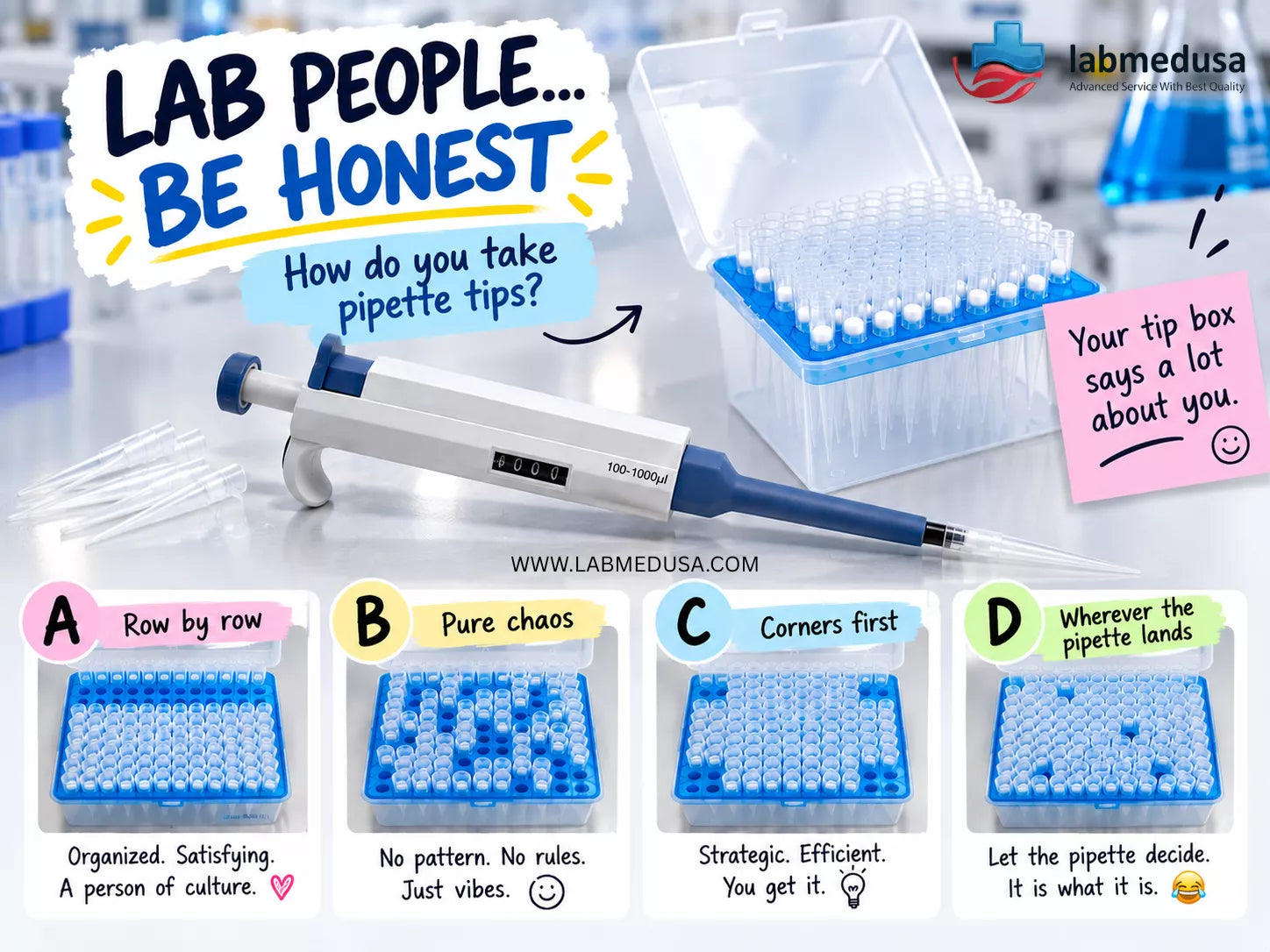
And, of course, every laboratory seems to have its own method for removing tips from the rack.
Row by row?
Corners first?
Randomly across the rack?
Your tip box may say more about your lab habits than you think.
How to Aspirate Liquid More Consistently
Proper aspiration technique can have a significant effect on pipetting repeatability.
For routine forward pipetting:
1. Select the appropriate volume
Make sure the selected volume falls within the operating range of the micropipette.
2. Attach the pipette tip
Insert the pipette cone into the tip and create a secure seal without applying unnecessary force.
3. Press the plunger to the first stop
Do this before placing the pipette tip into the sample.
4. Immerse the tip into the liquid
Only immerse the tip as deeply as necessary for the volume and vessel being used.
5. Keep the micropipette relatively vertical
Excessive pipette angles during aspiration can affect the air column and liquid handling.
6. Release the plunger slowly
Allow the liquid to enter the tip smoothly.
Rapid aspiration can encourage bubble formation and inconsistent liquid uptake.
7. Pause briefly
Give the liquid column a moment to stabilize.
8. Withdraw the tip
Remove it smoothly from the sample.
9. Dispense into the receiving vessel
Use consistent plunger movement according to the micropipette's operating instructions.
10. Eject the used tip
Change tips according to the sample, application, and laboratory procedure.
Why Pipette Angle Matters
A common pipetting mistake is aspirating while holding the micropipette at a strong angle.
Air-displacement pipettes depend on the relationship between the piston, air cushion, and liquid column.
Changing the orientation during aspiration can alter this relationship.
For routine aqueous liquid handling, keeping the micropipette approximately vertical during aspiration generally provides a more consistent technique.
Angling may also allow liquid to contact a larger area of the tip wall than necessary.
Why Aspiration Speed Matters
Faster is not always better.
If the plunger is released too quickly, liquid may rush into the tip.
This can contribute to:
- Bubble formation
- Splashing
- Inconsistent aspiration
- Aerosol generation
- Liquid contacting the filter
- Reduced repeatability
A smooth, controlled plunger release is usually preferable.
What Happens if Liquid Reaches the Filter?
The filter is intended to act as a protective barrier.
It should not normally be used as part of the liquid-holding volume.
If liquid reaches or saturates the filter, normal airflow through the tip may change and pipetting performance can be affected.
When this happens:
- Stop using the affected tip.
- Eject it according to laboratory procedures.
- Inspect the micropipette if contamination is suspected.
- Follow the laboratory's cleaning or decontamination procedure when necessary.
- Attach a fresh tip before continuing.
Avoid intentionally aspirating enough liquid to contact the filter.
Common Pipetting Mistakes
Releasing the plunger too quickly
This can cause bubbles, splashing, and inconsistent aspiration.
Using the wrong volume range
Micropipettes are designed to operate within specific volume ranges.
Using an incompatible tip
Poor tip fit can interfere with the air seal required for accurate aspiration.
Immersing the tip too deeply
Excessive immersion can influence pressure and coat more of the outside of the tip with sample.
Changing pipette angle during aspiration
Consistency in pipette position can help improve repeatability.
Reusing tips between samples
This creates an obvious pathway for sample-to-sample contamination.
Allowing liquid to reach the filter
The filter is designed as a barrier rather than a liquid reservoir.
Assuming the disposable tip determines accuracy
Tip quality matters, but micropipette calibration, operator technique, temperature, sample properties, and equipment condition also influence results.
Accuracy vs. Precision in Pipetting
These two terms are often used together, but they do not mean exactly the same thing.
Accuracy describes how close the transferred volume is to the intended volume.
For example, if a pipette is set to 1000µL, accuracy describes how close the actual delivered volume is to 1000µL.
Precision describes how consistent repeated transfers are with one another.
A pipette could repeatedly deliver 950µL when set to 1000µL.
Those transfers might be highly precise because they are similar to one another, but they would not be accurate because they are consistently below the target.
Good laboratory liquid handling aims for both.
Pipette Tips Cannot Correct a Poorly Calibrated Pipette
Even a well-manufactured pipette tip cannot compensate for a micropipette that is out of calibration.
Routine micropipette maintenance and calibration are therefore essential parts of a dependable liquid-handling program.
Laboratories should establish calibration intervals based on:
- Frequency of use
- Required accuracy
- Laboratory SOP
- Manufacturer recommendations
- Regulatory requirements
- Quality-management procedures
Pipettes used heavily or for critical measurements may require more frequent verification than instruments used occasionally for non-critical work.
When Should You Consider 1000µL Filter Pipette Tips?
A 1000µL filtered format can be useful when relatively large micropipette volumes are needed together with an additional barrier between the sample and the pipettor.
Possible applications include:
- Buffer preparation
- Sample aliquoting
- Reagent transfer
- Dilution preparation
- Molecular biology workflows
- Research samples
- Laboratory quality-control materials
- Educational laboratory procedures
- Routine laboratory liquid handling
Always select pipette tips according to the requirements of the procedure being performed.
1000µL Filter Pipette Tip Specifications
Maximum capacity: 1000µL / 1mL
Material: Polypropylene
Design: Filter pipette tip
Filter: Internal aerosol barrier
Appearance: Clear / transparent
Format: Pre-racked
Fit: Universal-style design for compatible micropipettors
Application: Laboratory liquid handling
For current packaging information, availability, and complete product specifications, refer to the product listing before ordering.
Watch the Micropipette and Filter Tips in Use
[Watch the Micropipette video here]
For additional photos, demonstrations, and laboratory content, visit Further Detail.
The Pipette Tip Is Part of the Measurement System
The micropipette may perform the mechanical measurement, but the disposable tip is an important part of the liquid-handling system.
Reliable pipetting depends on several factors working together:
Micropipette + compatible tip + proper technique + calibration + appropriate workflow
Filtered 1000µL pipette tips add another level of separation between the sample and pipettor while providing the convenience of disposable, pre-racked tips for routine laboratory use.
Understanding how these components work together can help laboratory professionals make better decisions about liquid handling, contamination control, and everyday pipetting technique.
Explore pipette tips, liquid-handling products, specimen collection supplies, laboratory consumables, and other professional lab supplies at LabMedUSA



Leave a comment